The Canadian automotive sector in numbers: a stable market, not growing
Sales plateauing
According to Statistics Canada, 1,866,714 new motor vehicles were registered in Canada in 2025, an increase of only 0.7% compared to 2024. The firm DesRosiers Automotive Consultants reaches a similar conclusion: the market ended 2025 at approximately 1.90 million units, up 2.0%, in a year it describes as marked by tariffs and policy changes from the United States.
The trend is not improving in 2026. According to DesRosiers, approximately 950,000 light vehicles were sold in the first half of 2026, 2.6% less than in the first half of 2025.
For a general manager, this means you can no longer rely on an expanding market to grow revenue. Every customer retained is therefore worth more.
Quebec, a leader in electric vehicles, undergoing major transition
Quebec remains the province where electrification is most advanced, but it is experiencing a significant change in pace. The Roulez vert program has been reduced in several stages: the maximum rebate for a new all-electric vehicle fell to $4,000 in 2025, then to $2,000 on January 1, 2026, and the program is set to end on January 1, 2027. For new plug-in hybrids, the rebate fell to $1,000 in 2026.
The effects are visible in the data. Statistics Canada reports that registrations of new zero-emission vehicles (ZEVs) fell 34.7% in Canada in 2025, and Quebec recorded a decline of 45.7% year-over-year in the third quarter of 2025. In the first quarter of 2026, however, ZEVs represented 10.8% of new registrations in Canada, and their number increased 15.8% compared to the first quarter of 2025.
In parallel, non-plug-in hybrids have gained ground. According to S&P Global Mobility data reported by RPM, they represented 17.7% of registrations in Canada in the second quarter of 2025, compared to 9.2% for ZEVs.
After-sales service: where profitability is decided
Customers spending more, but not visiting more often
The JD Power 2026 Canada Customer Service Index – Long-Term study, published on September 10, 2026 and conducted among 10,262 vehicle owners aged 4 to 12 years, provides valuable insight. The average spending per maintenance visit at a dealership reached a peak of $566, up 5% year-over-year. Dealerships receive 49% of maintenance visits but capture 63% of service revenues.
On the other hand, visit frequency is not changing: it remains at 1.8 visits per year at the dealership. In other words, the service market is not growing. According to JD Power, the opportunity to seize is therefore less in market growth than in retention, through the quality of the service experience.
Independent shops catching up to dealerships
The same study shows that secondary market service centers (chains and independent shops) outperform dealerships on three key elements: client-centered advice (91% vs. 89%), first-time fixes (94% vs. 91%) and quick vehicle return (69% vs. 52%). Year-over-year, satisfaction increased 13 points among independent shops and 6 points among chains, compared to just one point at dealerships.
Conversely, 47% of dealership customers say they chose their dealership because of their past experience with after-sales service. This is by far the top reason cited, ahead of proximity (28%). A good shop visit is therefore the best argument for the next one.
Electric vehicles, an advantage not to waste
Still according to JD Power, 42% of ZEV owners say they trust dealerships for complex repairs, compared to 36% of gasoline vehicle owners. Since Quebec has a high proportion of electric vehicles, this is a concrete advantage for Quebec dealerships, provided the experience is up to par.
Where customer experience is won or lost at the dealership
The situations below are typical examples, presented to illustrate the issues. They do not describe real documented cases.
Appointment scheduling and shop reception
In November, a customer tries to schedule an appointment to have her winter tires installed. She waits 15 minutes on the phone, then gives up and books at a specialty chain. No one at the dealership will know she was lost.
Useful indicators: time to obtain an appointment, rate of unanswered calls and CES (Customer Effort Score) measured after appointment scheduling.
Repair explanation and cost transparency
With an average bill that increases, every dollar must be justified. A customer who discovers a higher amount than expected at the counter, without being called beforehand, will feel cheated, even if the work was necessary.
Best practices: obtain customer approval before any estimate overages, send them photos or a short video of the part to be replaced and take two minutes at key handover to explain the work.
Useful indicators: average difference between estimate and invoice, rate of work approved remotely and CSAT on clarity of explanations.
Timelines and vehicle return
According to JD Power, fast vehicle return is precisely the area where dealerships lag furthest behind the secondary market (52% vs. 69%). Online payment, a text notice when the vehicle is ready and key handover without waiting are simple improvements to test.
Useful indicators: rate of vehicles ready on time promised and wait time at the counter during return.
Vehicle delivery and new powertrains
A customer buying their first plug-in hybrid wants to know how to charge it at home, what range to expect in winter and when to schedule the first service. If the advisor rushes through the delivery, questions will come later, often in the form of dissatisfaction.
Best practice: a delivery checklist adapted to each powertrain, followed by a call in the days that follow.
Follow-up after the visit
A short survey sent after delivery or a shop visit allows you to identify a dissatisfied customer before they leave a negative online review or go elsewhere for their next service.
Measuring to better manage: NPS, CSAT and CES
To improve customer experience, you must measure it regularly and at the right time. Three indicators complement each other:
- The NPS (Net Promoter Score) measures the likelihood that a customer will recommend your dealership. It provides an overall reading of loyalty.
- The CSAT (Customer Satisfaction Score) measures satisfaction after a specific interaction: a service visit, a delivery, a parts counter visit.
- The CES (Customer Effort Score) measures the effort expended by the customer, for example to schedule an appointment or get a response.
The key is to associate each indicator with a journey step: CES after appointment scheduling, CSAT after each shop visit and NPS a few weeks after vehicle delivery. You then know where the problem is, not just that there is one.
Five-step action plan for your dealership
- Map the customer journey, from test drive request through third service.
- Choose an indicator for each critical step, prioritizing after-sales service: appointment scheduling, work explanation, vehicle return.
- Collect feedback within 24 to 48 hours of the visit, while the experience is still fresh.
- Quickly follow up with each dissatisfied customer, with a designated responsible party and set callback timeframe.
- Share results monthly with teams: sales advisors, technical advisors and technicians must see the impact of their work.
How Monexpe can support your dealership
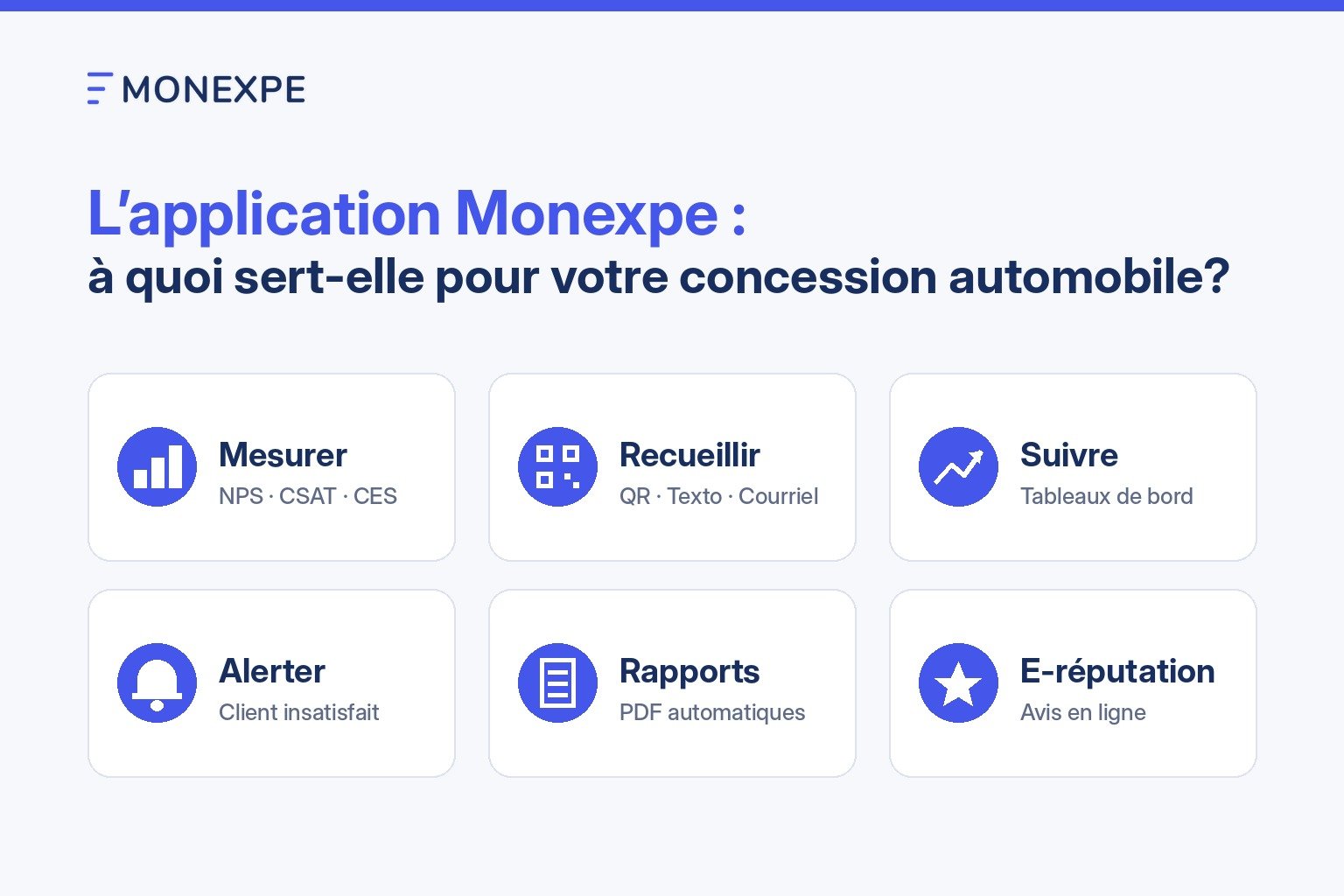
Monexpe is a customer experience measurement and management platform. It allows you to collect feedback from your customers, measure their satisfaction with NPS, CSAT and CES, track the evolution of your results and better manage your online reputation.
In a market where growth comes through retention, these tools help you identify pain points in after-sales service, intervene before a dissatisfied customer leaves and verify that your improvements are delivering results.
Conclusion
The automotive sector in Canada and Quebec is not in crisis, but it has changed in nature. Sales are plateauing, rebates for electric vehicles are disappearing, powertrains are diversifying, and after-sales service is becoming more profitable but also more competitive. Dealerships that measure and improve their customer experience at each step will be best positioned to retain their customer base.
Want to know what your customers really think about their visit to you? Discover Monexpe or request a demo.