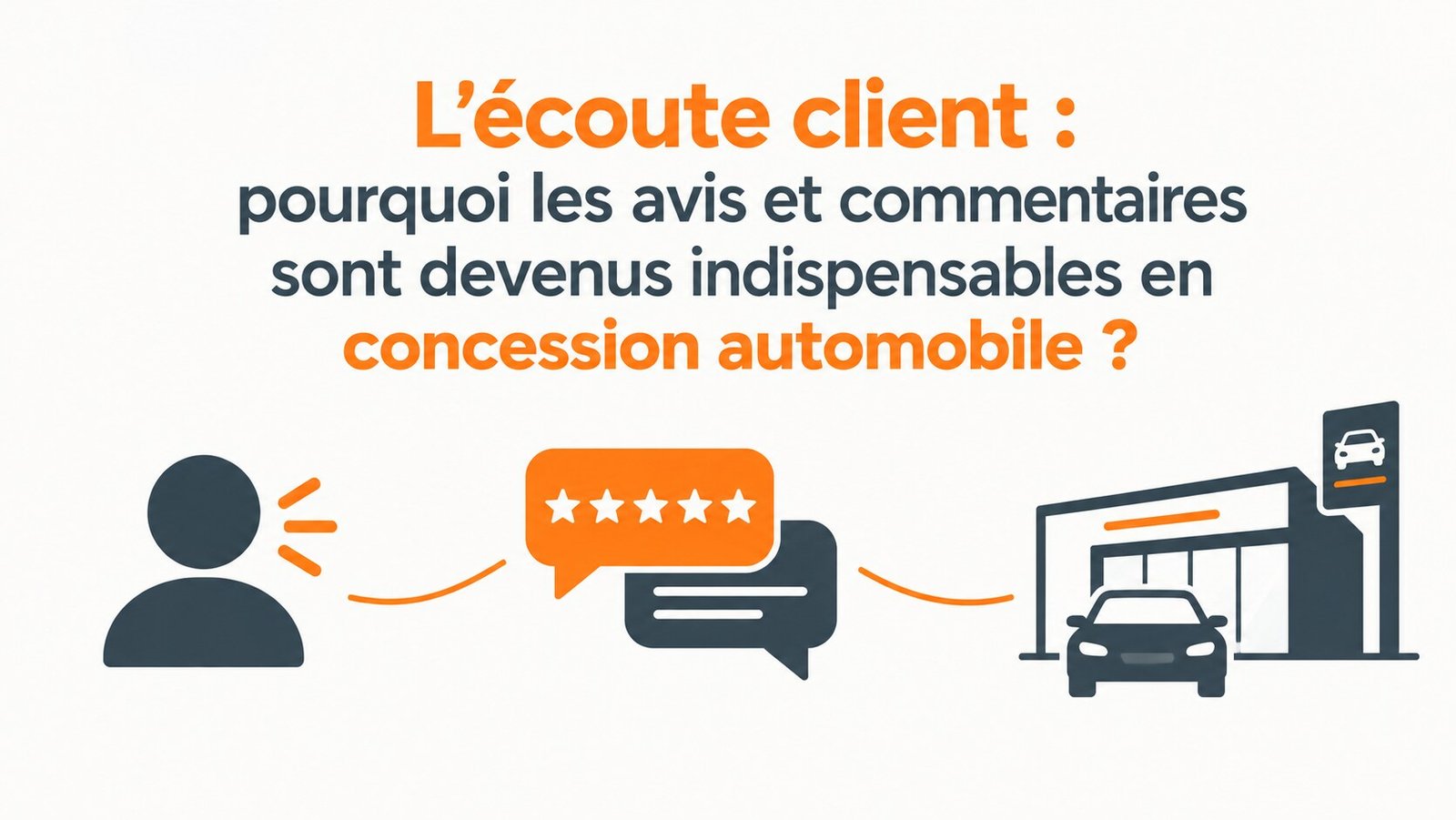
In the automotive sector, customer reviews and feedback have become essential because they are the most direct way to know, in real time, what brings a customer back or makes them leave. Financial results come too late and don't explain why. Customers are already speaking out: in surveys, online reviews, complaints at the counter, and conversations with advisors.
The challenge is no longer to get them to speak, but to gather these scattered messages and draw decisions from them. Here's why customer listening has become a central issue for dealerships, which sources to use, and how to turn them into action.
Why customer listening has become essential
Competition is won through experience
In after-sales service, dealerships face competitors who are advancing quickly. The 2026 J.D. Power study on after-sales service in Canada was published on September 10, 2026 (Customer Service Index – Long-Term, 10,262 vehicle owners aged 4 to 12 years). According to it, satisfaction increased over one year by 13 points at independent shops and 6 points at chains, compared to just one point at dealerships. A dealership that doesn't know precisely what its customers appreciate and what irritates them is therefore flying blind.
Visits are no longer increasing
The same study indicates that the average number of shop visits remains stable, at 1.8 per year at dealerships. When visits aren't increasing, growth comes mainly through customer retention. Yet keeping customers requires knowing what they experience, and knowing it before they leave.
Customers speak out anyway
A dissatisfied customer who has no simple way to tell the dealership will tell others: their friends, in a public review, or by simply switching shops. Giving them a listening channel gives you a chance to fix the situation.
Five sources of listening for a dealership
1. Surveys after key moments
What they provide: regular and representative measurement, since they're sent to all customers after a specific moment (appointment booking, shop visit, vehicle delivery). NPS, CSAT, and CES allow you to track changes over time.
Their limitation: without open-ended questions, a score doesn't say what needs to be fixed.
2. Online reviews
What they provide: spontaneous feedback, visible to future customers, often written after a memorable moment, good or bad.
Their limitation: they don't represent the entire customer base. Very satisfied or very dissatisfied customers are more likely to write than others.
3. Complaints and grievances
What they provide: specific and often detailed situations that reveal the most serious failures.
Their limitation: many dissatisfied customers never complain. The absence of complaints doesn't mean everything is fine.
4. What field teams hear
What they provide: sales advisors, technical advisors, and reception staff hear every day remarks that appear nowhere else: "I had trouble reaching you", "I don't understand this line on the invoice", "My old advisor always called me back".
Their limitation: these remarks get lost if no one writes them down. A fixed time, during the weekly team meeting, is often enough to collect them.
5. Behavioral data
What they provide: what customers do, not just what they say: whether they return for the next service, cancelled appointments, abandoned calls, unanswered web requests.
Their limitation: they show that something is happening, but not why. It's when you cross-reference them with comments that they make sense.
Bringing sources together for an accurate picture
Taken alone, each source gives a partial picture. Brought together, sources confirm or contradict each other, and that's when listening becomes useful.
When sources agree: if surveys, reviews, and advisor remarks all mention delays in vehicle delivery, the diagnosis is solid. It's a priority.
When they diverge: if shop surveys are good but online reviews are mostly negative, you need to understand why. Is the survey sent to all customers? Is a very dissatisfied minority speaking louder? Is a real problem being missed by the survey?
Fictional example, for illustration: a dealership in Beauce gets good CSAT results for the shop, but notices a rise in cancelled appointments. Technical advisors report that several customers complain about not being able to reach the shop to modify their appointment, and recent online reviews say the same thing. The problem wasn't the visit itself, but the phone line, which the post-visit survey didn't measure. The dealership adds a CES after appointment booking and an online modification option.
Turning listening into action: a four-step method
1. Centralize
Bring comments from all sources together in one place. A shared file can be enough to start, as long as someone is responsible for it.
2. Sort by theme
Classify each comment according to:
- the service involved: sales, financing, delivery, shop, parts;
- the theme: delays, cost transparency, repair explanations, greeting, communication, cleanliness.
After a few weeks, dominant themes will emerge.
3. Decide
Each month, during a brief review with department managers, choose one or two irritants to fix, with an owner and a deadline. Also read a few positive comments: they indicate what you need to preserve.
4. Close the loop
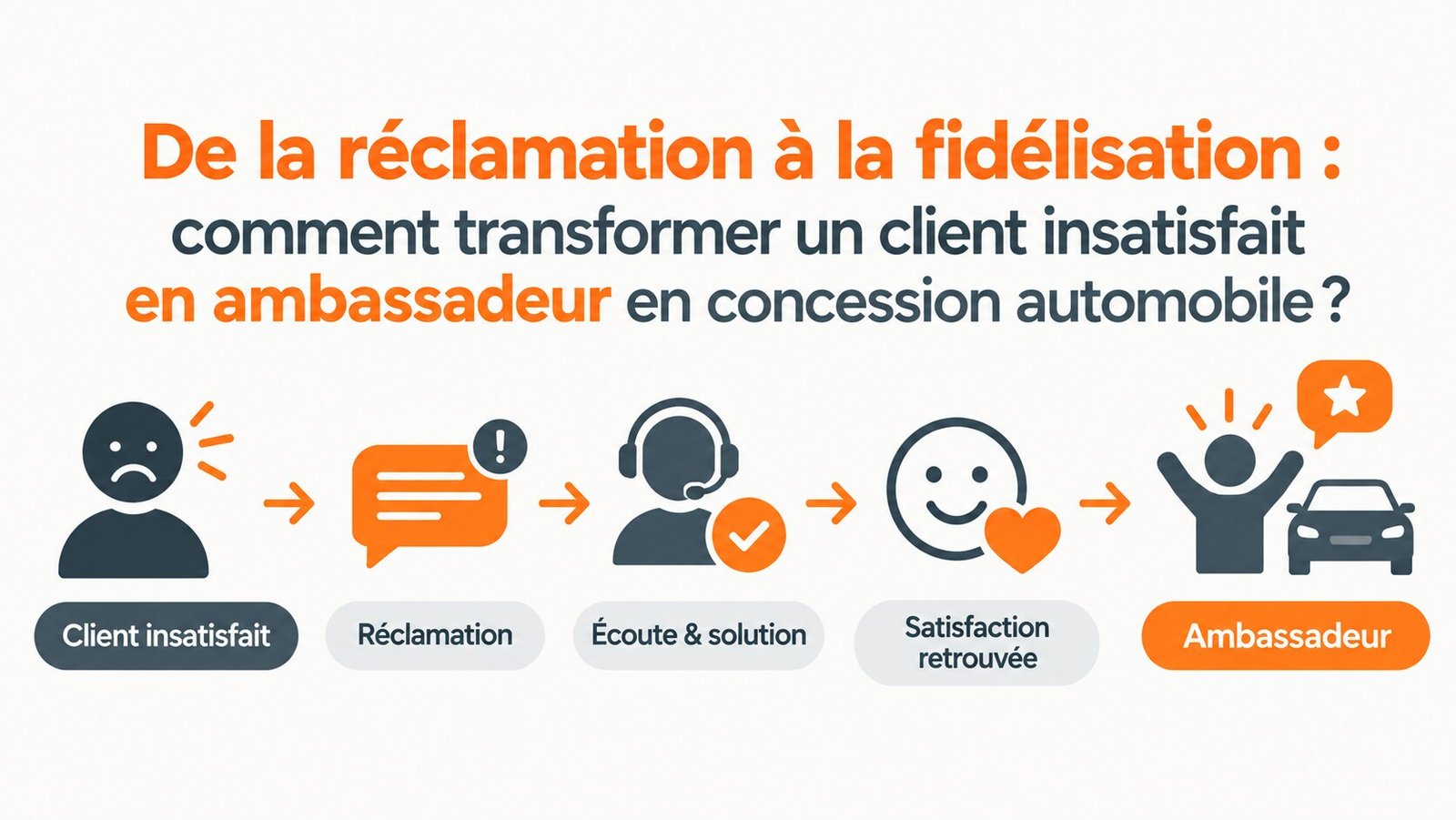
Listening only has value if the customer sees that it makes a difference. Call back dissatisfied customers, mention improvements in your review responses, and inform teams of changes made thanks to their feedback.
Indicators to track your customer listening
- survey response rate, to verify that customers are willing to speak up;
- time to call back dissatisfied customers;
- response rate to online reviews;
- number of actions decided and completed each quarter based on feedback;
- evolution of dominant themes: a fixed irritant should appear less often in feedback from following months.
Respecting the customers you listen to
Listening to customers also means responsibility. In Quebec, Bill 25 governs the collection and use of personal information, and sending surveys by email or text must comply with Canada's Anti-Spam Law (CASL). Solicit customers in moderation, explain to them what their responses are for, and have a legal advisor validate your practices if in doubt.
How Monexpe can help you
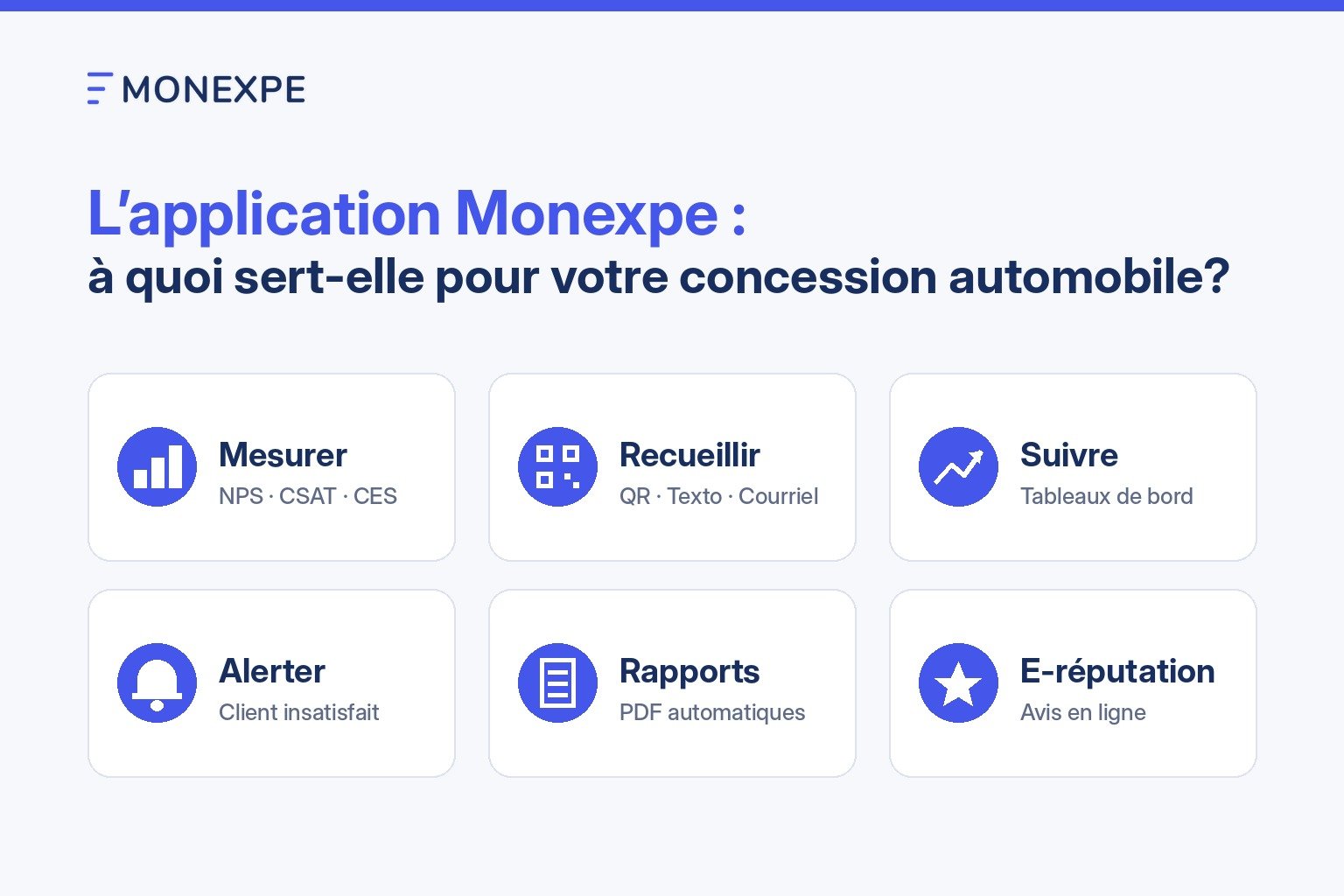
Bringing together listening sources and drawing decisions from them requires a tool that centralizes feedback and tracks its evolution. Monexpe is a customer experience measurement and management platform. It allows you to:
- collect feedback;
- measure satisfaction with NPS, CSAT, and CES;
- track results over time;
- better manage your online reputation.
For a dealership, this helps bring surveys and online reviews together, identify recurring themes, and verify, month after month, whether the actions taken are changing what customers are saying.
In summary
In the automotive sector, customers are already speaking: in surveys, reviews, complaints, and conversations at the counter. What sets dealerships that retain customers apart is their ability to bring these messages together, draw priorities from them, and show customers that their feedback changed something. Customer listening isn't a communication exercise: it's a management tool.
Want to better hear what your customers are already telling you? Discover Monexpe or request a demo.