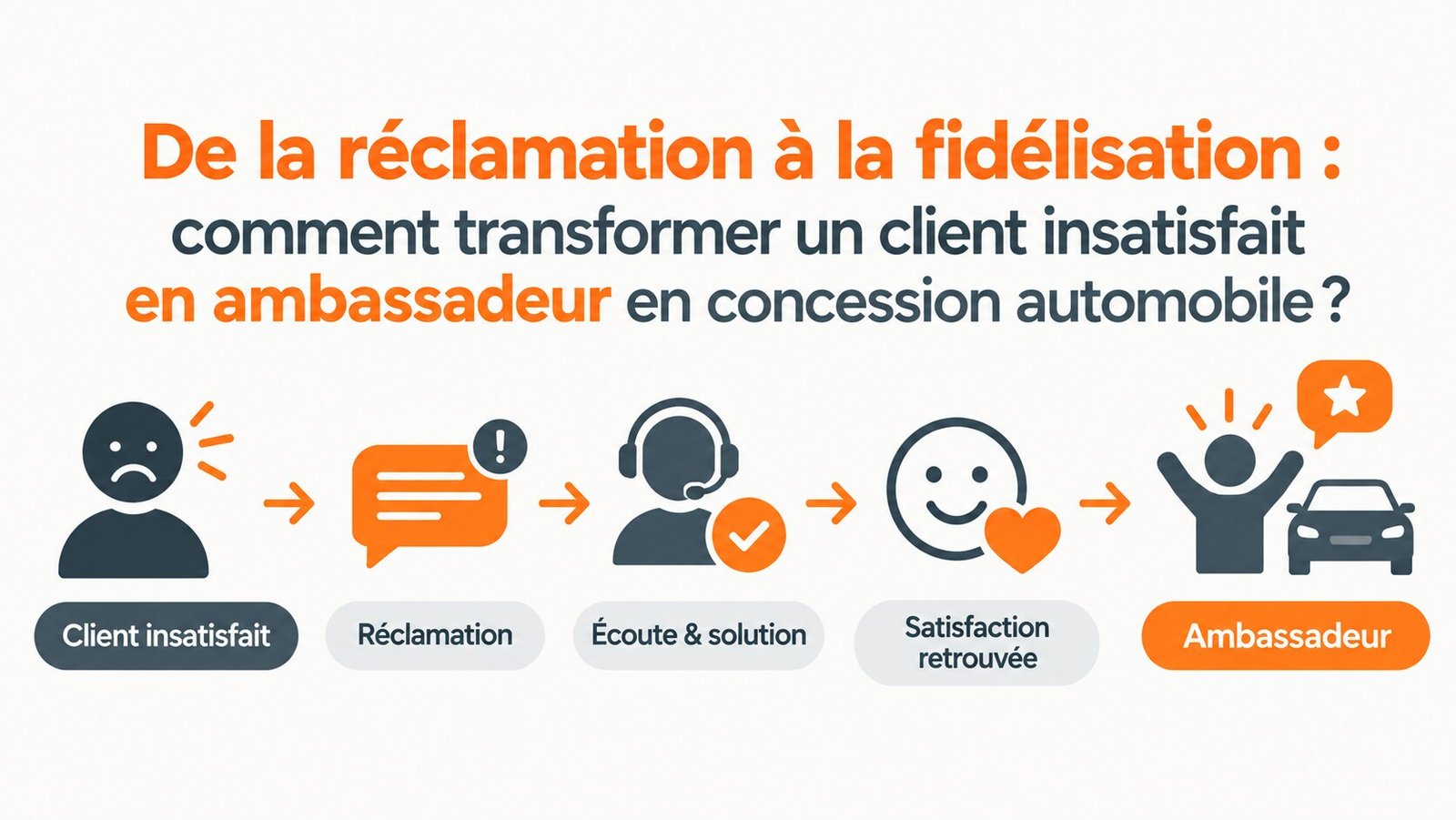
In the automotive sector, a well-handled complaint can save a relationship, and sometimes strengthen it. To achieve this, a dealership must follow five steps:
- receive the complaint without defending yourself;
- understand what the customer expects;
- propose a concrete solution within an announced timeframe;
- follow up;
- correct the cause to prevent the situation from recurring.
A customer does not become an ambassador because you apologized, but because they saw that the dealership kept its word. Here's how to implement this process, with concrete examples and indicators to track.
Why every complaint matters
A dissatisfied customer who complains gives you an opportunity. One who says nothing often leaves without warning, for their next service or their next purchase.
In after-sales service, the relationship is largely based on the experience. The J.D. Power 2026 study on after-sales service in Canada was published on September 10, 2026 (Customer Service Index – Long-Term, 10,262 vehicle owners aged 4 to 12 years). According to it, 47% of dealership customers say they chose their dealership because of their past experience with after-sales service. A poorly handled complaint erases this advantage.
Conversely, a well-handled complaint shows the customer what they can expect from you when something goes wrong. It is often at this moment that trust is truly built.
The most common complaints at a dealership
They generally fall into a few situations:
- a bill higher than the estimate, or work done without clear agreement;
- a repair that needs to be redone, or a problem that returns after the visit;
- a vehicle not ready at the promised time, without warning;
- a vehicle delivery that is rushed: incomplete documents, missing accessories, explanations too quick;
- a call or email left unanswered;
- a vehicle returned dirty or damaged.
Knowing these situations allows you to prepare responses and identify recurring irritants.
The five-step process
1. Receive the complaint without defending yourself
The first instinct is often to justify yourself: "The technician did what was planned." Even if it's true, this response closes the discussion. The customer wants to be heard first.
What to do: listen through to the end, restate the problem, acknowledge what the customer experienced, and tell them who will handle it.
Example response: "I understand that you expected a bill of around $300 and received one for $520 without being called. That's not the experience we want to offer you. I will check the file with the technical advisor and call you back before 3 p.m. today."
All complaints must be recorded in the same place, regardless of the channel: at the counter, by phone, by email, in a survey, or in an online review.
2. Understand what the customer expects
Two customers who experience the same situation don't necessarily expect the same thing. One wants a partial refund, another wants an explanation, a third just wants the problem fixed and not to happen again.
What to do: verify the facts (work order, estimate, exchanges with the customer), then simply ask: "What would be a fair solution for you?" The answer is often more reasonable than you might fear.
3. Propose a solution within an announced timeframe
Speed is as important as the solution itself. A customer waiting a week for a response to their complaint experiences a second dissatisfaction.
What to do:
- assign the complaint to someone with the authority to decide, for example the after-sales service director for the workshop;
- announce a response timeframe and stick to it;
- propose a concrete solution: redo the work at no cost, provide a detailed explanation of the bill, make a proportionate goodwill gesture, offer priority for the next appointment.
A goodwill gesture is not always necessary. When the dealership is right on the facts, a clear and respectful explanation can be enough. What matters is that the customer understands the decision.
4. Follow up after resolution
This is the most often forgotten step, and yet the one that makes the most impact. A few days after the solution, a call or message shows the customer that the dealership cares about the result, not just closing the file.
Example message: "Hello Ms. Tremblay, we realigned your vehicle on Tuesday. I wanted to make sure everything is working well since then. If something isn't right, you can reach me directly at this number."
5. Correct the cause so the situation doesn't happen again
A complaint handled is a customer recovered. A cause corrected is dozens of customers spared. Each month, group complaints by theme and choose one recurring irritant to correct, with a responsible person and a specific action.
Fictional example, for illustration: a dealership in the Laurentians receives several complaints about bills exceeding the estimate. Analysis shows that additional work is often approved by phone, without a written record, and the customer doesn't remember the announced amount. The dealership decides to systematically send the revised estimate by text, with a photo and approval link, before any additional work. In the following months, it tracks the number of complaints on this topic.
Mistakes that turn a complaint into a departure
Respond too late. The longer the wait, the more time the customer has to tell their experience to friends or online.
Blame an employee or the manufacturer. For the customer, it is the dealership that is responsible for their experience.
Promise without delivering. "We'll call you back tomorrow," followed by no call, is often worse than the original problem.
Make the customer repeat themselves. Each person who takes over the file must already know its history.
Negotiate the removal of a negative review. Offering a goodwill gesture in exchange for removing a review violates the rules of platforms like Google. Fix the problem; the customer will choose whether to update their review or not.
Know the Quebec framework
In Quebec, the Consumer Protection Act regulates, among other things, auto repair, including written estimates and warranty on repairs. A dissatisfied customer can also contact the Office of the Protector of the Consumer. For manufacturing issues or manufacturer warranty issues, there is a dispute resolution program in Canada: the Program for Arbitration of Vehicular disputes (PAVAC).
Knowing these rules helps teams respond correctly and resolve the situation before it takes a more formal turn. In case of doubt, have a legal advisor validate your practices.
Indicators to track
- the time to first response to a complaint;
- the resolution time, from receipt to solution;
- the share of complaints resolved on first contact;
- satisfaction after resolution, measured by a short CSAT sent once the file is closed;
- the return rate at the next service for customers who made a complaint;
- the number of complaints by theme, to verify that corrected causes decrease.
Detect dissatisfaction before it becomes a complaint
Many dissatisfied customers never complain. A short survey sent after each workshop visit or after delivery allows you to identify those who had a bad experience, and call them back before they leave or post a negative review. It is often the most effective way to act early.
How Monexpe can help you
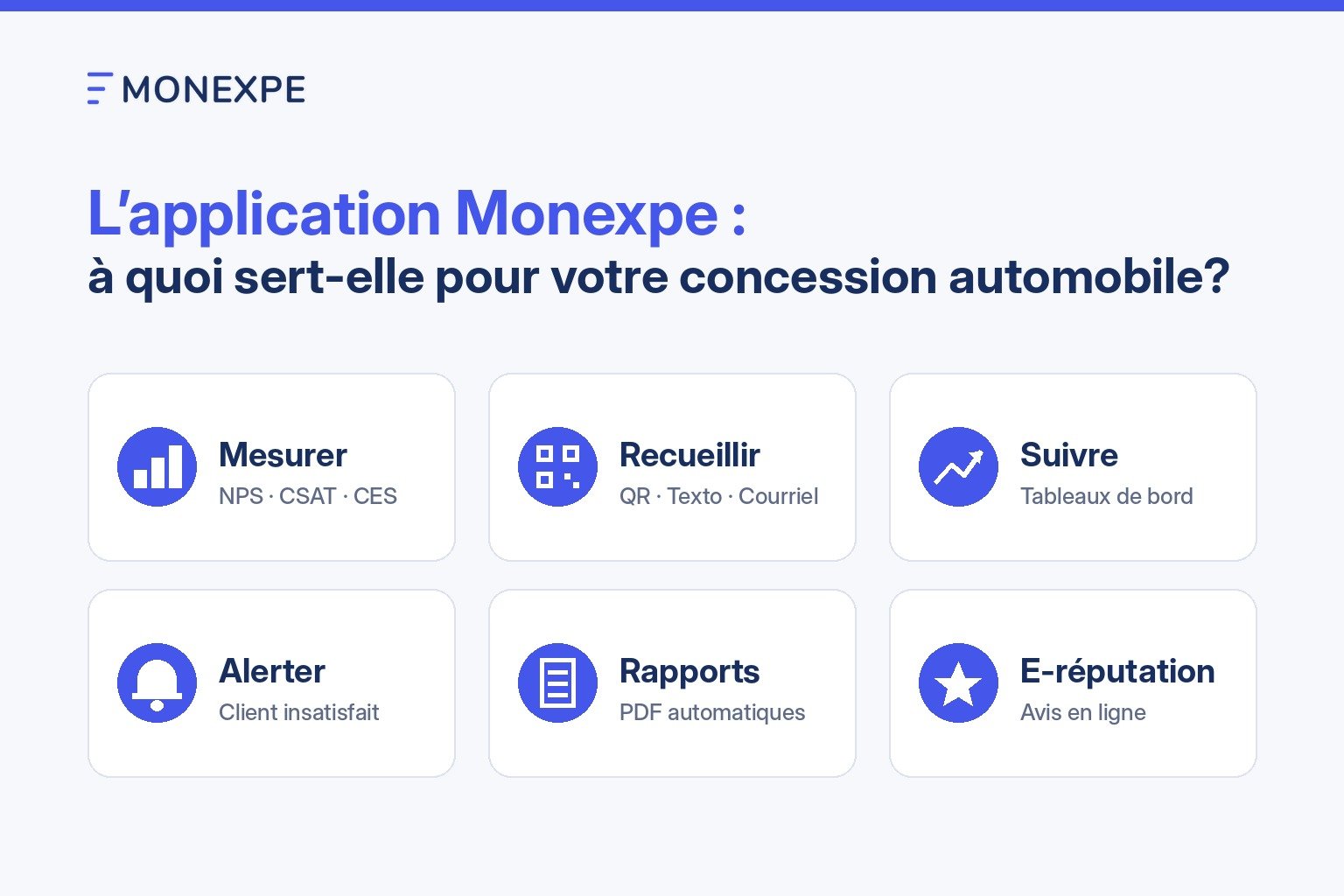
To recover a dissatisfied customer, you first need to know they are. Monexpe is a customer experience measurement and management platform. It allows you to:
- gather feedback;
- measure satisfaction with NPS, CSAT, and CES;
- track results over time;
- better manage your online reputation.
For a dealership, this helps quickly identify customers who express dissatisfaction after a visit, track recurring topics of discontent, and verify whether corrected causes actually reduce complaints.
In summary
In the automotive sector, a complaint is not a failure, it's a moment of truth. Dealerships that receive complaints without defending themselves, respond quickly, keep their promises, follow up, and correct causes regain the trust of many dissatisfied customers. Some may become ambassadors; all will have at least one concrete reason to return.
Want to identify your dissatisfied customers before they leave? Discover Monexpe or request a demo.