In the automotive sector, the first contact hinges on three elements: the speed of response, its relevance, and the next step proposed. A customer who writes to a dealership, calls the workshop, or enters the showroom wants to feel seen, wants to know that their request has been understood, and wants to know what happens next. If any one of these elements is missing, they compare, and they often have already contacted another dealership.
This first contact is not only about sales. For an after-sales customer, the call to book an appointment or the welcome at the workshop sets the tone for the entire visit. Here's how to succeed at these first moments, and how to know if your dealership is truly succeeding at them.
Why the first contact matters so much
The first contact is the moment when the customer decides whether your dealership deserves their time. They have no history with you yet: they judge based on what they see and hear. A delay, a generic response, or a distracted welcome become signals, even if they don't reflect the real quality of your teams.
The same applies at the workshop. In Canada, the J.D. Power 2026 study on after-sales service for vehicles 4 to 12 years old (CSI-LT, September 2026) indicates that 47% of customers who have their vehicle serviced at a dealership chose it because of their previous service experience. Each first contact at the service department therefore prepares the next visit.
The problem is that these moments are difficult to see from the inside. A Web request without a response or a call abandoned on hold leaves no trace in a sales report. To improve them, you must first make them visible.
What studies show about dealership responsiveness
There is little public data on Quebec. The most detailed studies come from the United States, where the firm Pied Piper sends mystery customer requests to dealerships each year. They don't translate directly to the Quebec market, but they clearly show where the gaps lie.
In the Pied Piper 2025 study on Web request responses (Internet Lead Effectiveness, United States), 40% of evaluated dealerships achieved a score above 80, which corresponds to a personalized, rapid, and complete response. Conversely, 19% scored below 40: they did not respond to the customer personally. Dealerships responded through multiple channels (email, phone, text) in 49% of cases, compared to 44% the previous year.
On the after-sales side, the Pied Piper 2025 study on telephone effectiveness at service (Service Telephone Effectiveness, United States, calls to 2,105 dealerships) shows that the share of customers who hung up before being offered an appointment fell from 13% to 9%. The irritants noted:
- asking the customer to call back later;
- directing them to voicemail;
- putting them on hold;
- losing the call during a transfer.
The finding is the same on both sides: the gap between the most responsive dealerships and the others is significant, and it comes down to simple gestures.
The four first contacts at an automotive dealership
1. Web request for sales
The customer has filled out a form on your website or on a marketplace. They often ask a specific question: is the vehicle available? What is the all-inclusive price? Can we do a test drive on Saturday?
What makes a good first impression: a personalized and rapid response that answers the question asked, proposes a concrete next step (an appointment, a test drive), and is signed by a named advisor. Best practices observed by Pied Piper combine a written response and a call.
Common mistakes: automatic response with no follow-up, template that ignores the question, no appointment proposal, persistent follow-ups with no added value.
Indicators: average time for first personalized response (during and outside business hours), share of responses that actually answer the question, rate of requests converted to appointments.
2. Telephone call, for sales and service
The telephone remains a key channel, especially at after-sales service. The customer calls to book an appointment, report a noise, or find out where their vehicle is.
What makes a good first impression: a call answered quickly by a person who introduces themselves, understands the request, and proposes a specific date and time before the end of the call. If a transfer is necessary, it must be announced and completed.
Common mistakes: prolonged wait, full voicemail, lost transfer, "call back tomorrow," or "bring it in" without an appointment or estimated time.
Indicators: rate of abandoned calls, average wait time, share of service calls that end with a confirmed appointment, CES after appointment booking.
3. Showroom welcome
The customer who enters the showroom has often already made part of their choice online. They want to be welcomed quickly, without pressure, by someone who knows their file if they have already made contact.
What makes a good first impression:
- a welcome within the first few minutes, even if the advisor is busy ("I'm with a customer, I'll be with you in five minutes");
- a vehicle ready for the test drive when an appointment has been made;
- an advisor who has reviewed previous exchanges.
Common mistakes: customer left alone in the showroom, advisor asking all the questions already asked online, reserved vehicle not found or not prepared.
Indicators: appointment show rate, CSAT on welcome after visit, open-ended question about what the customer had to repeat.
4. Workshop welcome
At after-sales service, the first physical contact takes place at the workshop reception, often early in the morning, when several customers arrive at the same time. In the United States, the J.D. Power 2025 study on dealership service (Customer Service Index, March 2025) ranks among the most influential indicators of satisfaction the fact that the technical advisor meets the customer upon arrival.
What makes a good first impression:
- a recognized customer: their appointment is scheduled, their work is known;
- an advisor who validates the work and planned return time with them;
- a clear explanation of what comes next: how they will be informed if additional work is needed, and at what cost.
Common mistakes: queue without attention, appointment not found, vague return time ("end of day"), no indication of how the customer will be kept informed.
Indicators: wait time at reception, share of vehicles ready at announced time, CSAT on service intake.
First contact standards at a glance
1. Web request
Standard to aim for: a personalized response that answers the question and proposes an appointment.
Indicators: time to first response; requests converted to appointments.
Suggested responsible: sales manager or business development center (BDC).
2. Service call
Standard to aim for: a specific appointment offered before the end of the call.
Indicators: abandoned calls; calls ending in an appointment; CES.
Suggested responsible: service manager.
3. Showroom welcome
Standard to aim for: a customer welcomed quickly, whose file is known.
Indicators: show rate; CSAT on welcome.
Suggested responsible: sales manager.
4. Workshop welcome
Standard to aim for: work and return time validated with the customer.
Indicators: wait time; vehicles ready on time; CSAT on service intake.
Suggested responsible: service manager.
These standards are starting points. Set your own response time targets based on your resources, then track their evolution month after month rather than aiming for a universal figure.
How to know if your dealership is succeeding at the first contact
Do the mystery shopper exercise
Send yourself a request through your website on a Tuesday evening, call the workshop on a Monday morning, observe the workshop reception at opening time. Note the delay, the content of the response, and the next step proposed. Repeat the exercise each quarter, across multiple channels.
Fictional example, for illustration: the general manager of a Laval dealership tests three Web requests. Two receive rapid responses, but in template form that doesn't mention the requested vehicle. The third, sent on a Sunday, isn't handled until Tuesday. The team adjusts their templates to always reference the customer's question, and appoints someone responsible for weekend requests.
Ask for customer feedback at the right time
The mystery shopper shows what you do; the real customer says what they felt. One or two questions sent shortly after the first contact are enough: CES to know if booking an appointment was easy, CSAT to judge the welcome, with an open question to understand why.
Track online reviews that mention the first contact
Comments like "nobody called me back" or "I waited 20 minutes at reception" are valuable: they point to a specific touchpoint. Group them by theme each month and respond by explaining what has been corrected.
Monexpe's role in this process
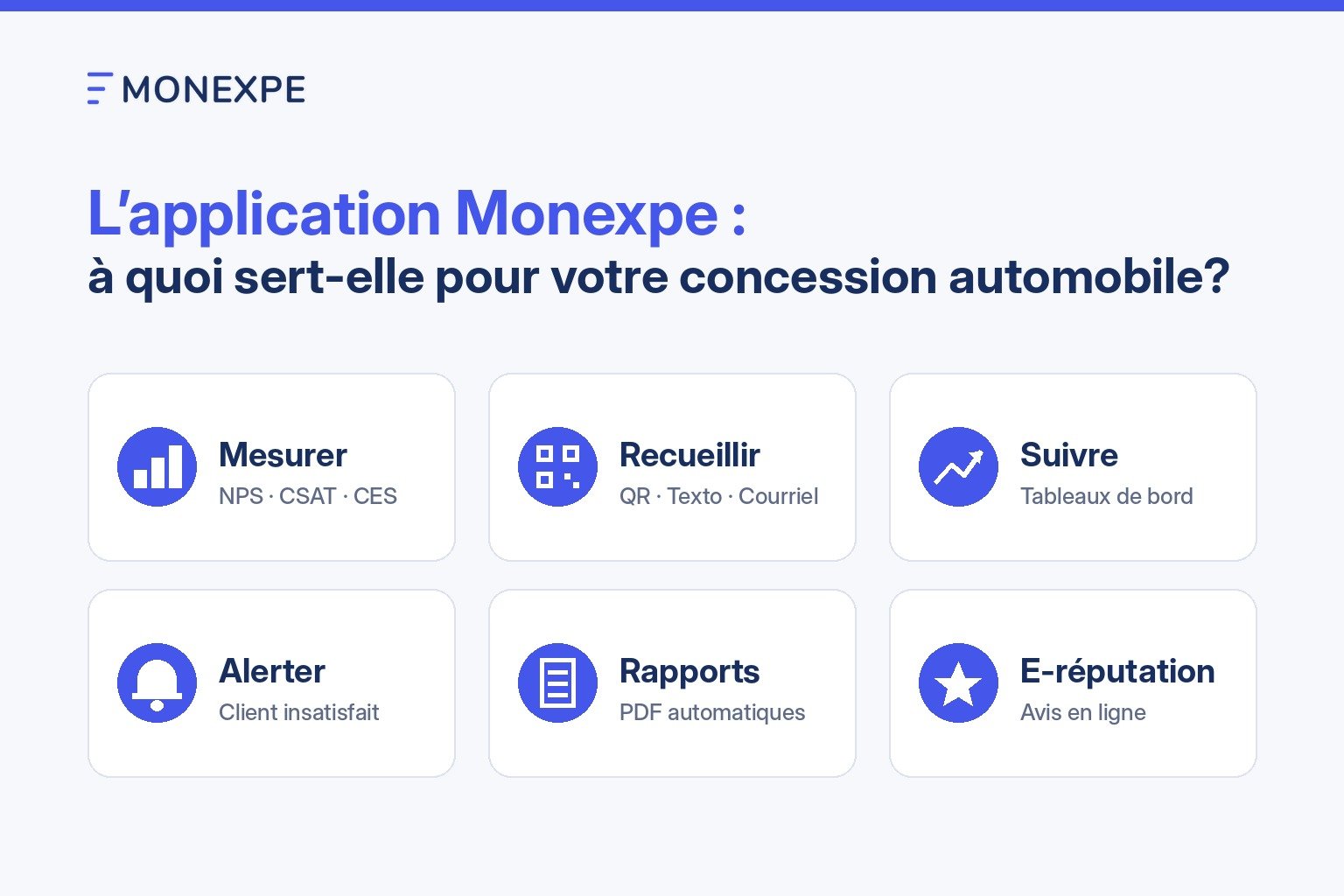
Improving the first contact requires listening to it regularly, not only when a complaint surfaces. Monexpe is a customer experience measurement and management platform. It allows you to:
- collect feedback from your customers;
- measure their satisfaction with NPS, CSAT, and CES;
- track results over time;
- better manage your online reputation.
For the first contact, this can take the form of a brief CES survey after a service appointment booking, a CSAT on the welcome after a visit, and monitoring of online reviews that mention the dealership's responsiveness.
In summary
In the automotive sector, first impression isn't limited to a smile at the welcome. It comes down to speed, the relevance of the response, and the clarity of the next step, across four touchpoints: the Web request, the telephone, the showroom, and the workshop reception. Test them yourself, ask your customers for feedback, and track a few simple indicators. That's often where appointments, sales, and ultimately customer loyalty are won.
Want to measure the quality of the first contact at your dealership? Discover Monexpe or request a demo.