In the automotive sector, the customer journey refers to all the stages experienced by a person, from their first online search to the purchase of their next vehicle.
At a dealership, it can be summarized in five major stages: online discovery, visit and test drive, vehicle delivery, maintenance at the after-sales service, and then renewal. This journey is not linear: the customer moves from the Web to the showroom, from the workshop to their phone, and judges your dealership based on the entire experience.
To improve it, you first need to see it clearly: identify the critical moments in each stage, name a responsible person, and track a simple metric. This guide shows you how to do it, step by step.
What is the customer journey in an automotive dealership?
The customer journey is the series of touchpoints between a person and your dealership: a vehicle listing viewed, a phone call, a test drive, a signature, a service appointment, a maintenance reminder. Each of these moments leaves an impression, and the sum of these impressions determines whether the customer will return.
In a dealership, this journey has a unique characteristic: it crosses multiple departments that often operate in silos. Sales, financing, delivery, and the workshop each have their own objectives, tools, and schedules. The customer, however, sees only one company. Problems most often appear when moving from one department to another.
The Five Stages of the Customer Journey and Their Critical Moments
1. Online Discovery and Shopping
Most journeys begin long before the first visit. According to a study conducted by DIG Insights for AutoTrader among Canadian consumers in February 2025, 88% of new vehicle buyers prefer to complete at least part of the purchase process online. Customers compare models, check inventory, read reviews, and sometimes send requests to multiple dealerships at the same time.
Critical moment: the first response. A delayed callback, a generic reply, or a vehicle listed that is no longer available is enough to drive the customer to a competitor.
2. Visit, Test Drive, and Negotiation
A customer who visits has already made part of their decision. They expect the sales advisor to pick up where the Web left off, without having to repeat what they've already indicated. The test drive, the trade-in valuation, and the price presentation are the sensitive points.
In the United States, the 2025 J.D. Power study on sales satisfaction (Sales Satisfaction Index, conducted among over 32,000 new vehicle buyers) demonstrates the weight of transparency. Among buyers who made a trade-in, 28% believe the value they received was below their expectations. However, their satisfaction with the negotiation is significantly higher when the dealer clearly explained how that value was determined: 800 points out of 1,000 with explanation, versus 672 without. While these are U.S. data, the principle applies to any dealership: a figure that is explained goes over better than one that is imposed.
Critical moment: the explanation of the trade-in valuation and final price.
3. Financing, Signing, and Vehicle Delivery
Delivery is often treated as a formality at the end of the transaction. Yet it is one of the moments customers remember most. In the same J.D. Power study (United States, 2025), the delivery process ranks first among the six factors that determine buyer satisfaction, ahead of staff, negotiation, documents, facilities, and the website.
The study also notes that 22% of buyers would like to receive, a few weeks after delivery, a new explanation of their vehicle's features, whether by phone, at the dealership, or via video. More than half of them (53%) never receive this follow-up.
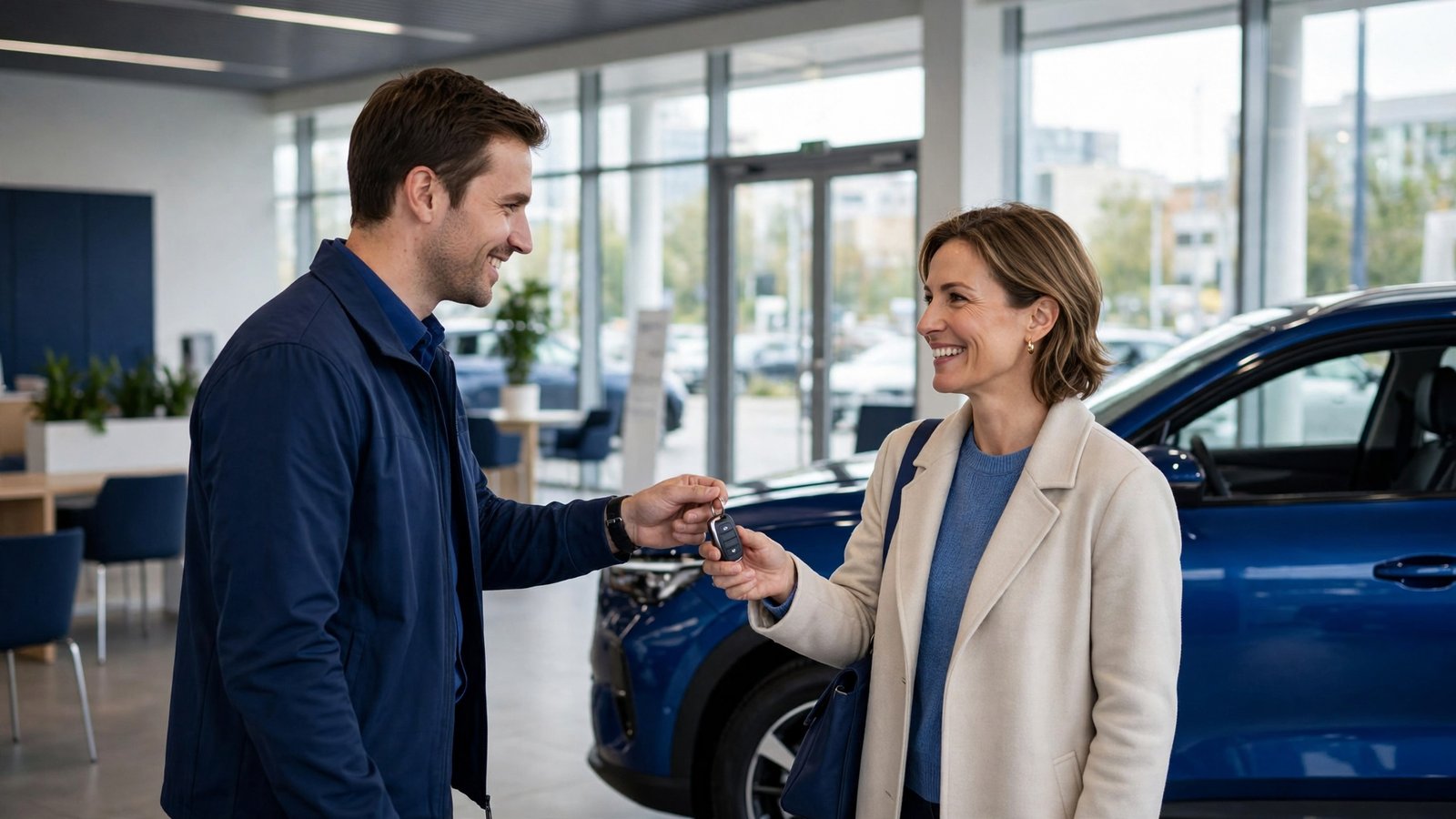
Critical moment: the handover of keys and the first contact after delivery.
4. Maintenance and After-Sales Service
After the sale, the relationship continues primarily at the workshop. In Canada, according to the 2026 J.D. Power study on long-term service (Canada Customer Service Index – Long-Term, published September 10, 2026), vehicle owners aged 4 to 12 years visit their dealership an average of 1.8 times per year for maintenance. According to the 2025 edition of this study, that figure was 1.5 in 2022. Each visit is an opportunity to confirm or erode the trust established at purchase.
Critical moment: the first workshop visit. This is often when the customer discovers whether the dealership recognizes them, whether stated timelines are met, and whether costs are explained.
5. Loyalty and Renewal
The journey doesn't end at the last invoice. A satisfied customer recommends the dealership, leaves a review, returns for their next vehicle, or refers a relative. Conversely, a disappointed customer often leaves without saying so, and the dealership only finds out when they buy elsewhere.
Critical moment: the renewal proposal and how the dealership treats a dissatisfied customer before they leave.
How to Map Your Dealership's Customer Journey
Mapping the customer journey doesn't have to be a major project. The key is to start from the reality experienced by your customers, not from the process as described in a manual.
Retrace the Journey as a Customer
Send a request through your website, call to book a service appointment, review automatic emails and texts sent to customers. Note the delays, repetitions, and moments where information is missing. Then bring together a representative from each department (sales, financing, delivery, workshop) to compare their perspectives.
Name a Responsible Person for Each Stage
A critical moment without a responsible person ends up being neglected. Each stage should have someone who tracks its results and who can decide on a change: the sales manager for responses to Web requests, the delivery manager for key handover, the after-sales service manager for the workshop.
Associate a Metric with Each Stage
Here's a foundation to adapt to your dealership.
1. Online Discovery
Critical moment: the first response to an inquiry.
Suggested responsible party: the sales manager or business development center (BDC).
Metrics: average first response time; appointment booking rate.
2. Visit and Test Drive
Critical moment: the explanation of the price and trade-in valuation.
Suggested responsible party: the sales manager.
Metrics: CSAT after the visit; visit conversion rate.
3. Vehicle Delivery
Critical moment: key handover and follow-up a few weeks later.
Suggested responsible party: the delivery manager.
Metrics: NPS after delivery; percentage of customers contacted after delivery.
4. After-Sales Service
Critical moment: the first workshop visit.
Suggested responsible party: the after-sales service manager.
Metrics: CSAT after the visit; CES after appointment booking; return to workshop for next maintenance.
5. Loyalty
Critical moment: handling a dissatisfied customer.
Suggested responsible party: management or the customer experience manager.
Metrics: response time for a dissatisfied customer; overall NPS; trend in online reviews.
Review Results Each Month
A dashboard consulted only once a year changes nothing on the ground. A brief monthly review by stage, with two or three customer comments read aloud, helps teams understand the concrete impact of their actions.
The Most Common Breaking Point: The Transition from Sales to the Workshop
In many dealerships, the customer "belongs" to the sales department until delivery, then becomes a file number for the workshop. Yet it is precisely this transition that determines whether they will return for maintenance.
Fictional example, for illustration purposes: a customer buys an SUV at a dealership in the Quebec City region. The delivery goes well. Six months later, she calls for her first maintenance appointment: she's asked for all her information again, no one knows she bought her vehicle there, and the proposed timeline is three weeks. She books an appointment at a quick-service center near her home. Nothing went "wrong" during the sale, but the link with the workshop was never made.
A few simple steps reduce this risk:
- introduce the customer to the service advisor or workshop team on the day of delivery;
- offer to book the first maintenance appointment before the customer leaves;
- pass along useful information noted by the sales advisor to the workshop (contact preferences, vehicle usage);
- track, month after month, the percentage of buyers who return for their first maintenance appointment.
Measuring Each Stage Without Overwhelming the Customer
Measuring the journey doesn't mean sending a survey after every call. A customer asked too often ends up not responding, and the results become less reliable. Better to choose a few key moments and associate the right metric with each: CES for a practical task like appointment booking, CSAT for a specific visit, and NPS for the overall relationship, after delivery or at regular intervals.
Two principles make the difference. The first is to break down results by stage and department, so each manager knows what to act on. The second is to contact dissatisfied customers quickly: a customer reached out to after a bad experience still has a reason to stay, while an ignored customer doesn't.
Where Monexpe Fits Into This Approach
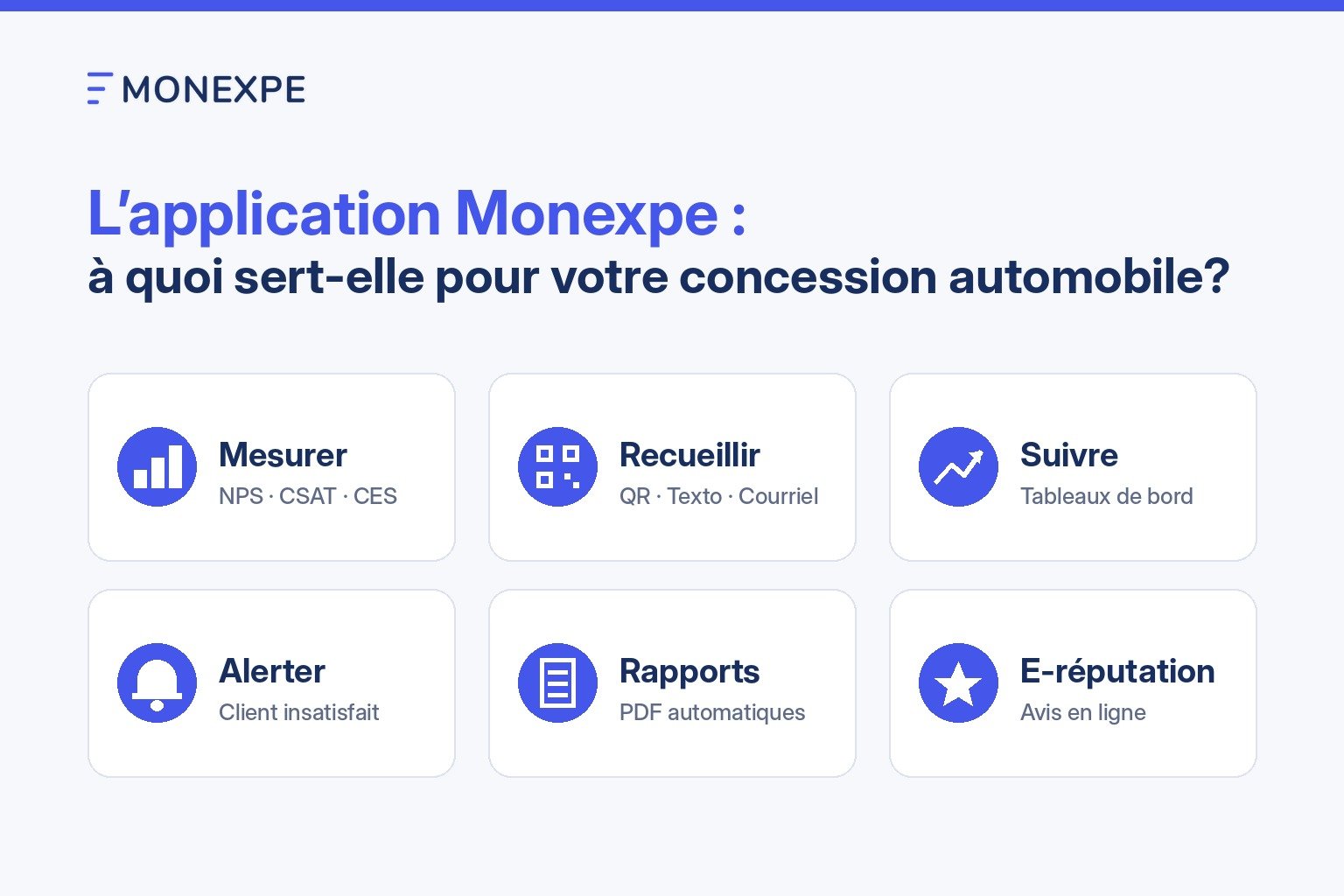
Once you've defined the stages and metrics, the challenge is to collect feedback at the right time and track results over time. Monexpe is a platform for measuring and managing customer experience: it allows you to collect customer feedback, measure their satisfaction with NPS, CSAT, and CES, track results over time, and better manage your online reputation.
Applied to a dealership's customer journey, it helps tie each measurement to a specific stage (visit, delivery, workshop), compare departments against each other, and identify customers to contact before dissatisfaction turns into a negative review or departure.
In Summary
The customer journey in the automotive sector goes beyond the sale. It begins online, passes through the test drive and vehicle delivery, and largely plays out at the workshop. The dealerships that build the most loyalty are those that see this journey as a whole: they know their critical moments, know who is responsible, and track a metric for each one. Start with the stage where you lose the most customers, then expand the approach.
Want to structure customer journey measurement at your dealership? Discover Monexpe or request a demo.