In the automotive sector, a friction point is a moment when the customer has to make an effort they shouldn't have to make: calling back because no one answered, repeating what they've already said, waiting at the counter, asking why the invoice is higher than expected.
To identify these moments, you need to cross-reference several sources:
- measure the effort felt by customers;
- analyze their comments;
- track the stages where they abandon;
- redo the journey yourself;
- listen to the teams.
Next, you need to prioritize the friction points, correct them one by one, and verify the results. Here's a concrete method for doing this at an automotive dealership.
Why friction points matter so much
A customer rarely judges a dealership on their entire journey. They mainly remember the moments when things became complicated, and a single poorly managed step is enough to create a gap with the competition.
Vehicle handover at the service department is a good example. In Canada, the J.D. Power 2026 study on after-sales service was published on September 10, 2026 (Customer Service Index – Long-Term, 10,262 vehicle owners aged 4 to 12 years). According to it, 52% of dealership customers say they recovered their vehicle quickly, compared to 69% of customers at independent shops and secondary market chains.
The signs that reveal a friction point
Before searching methodically, a few signs should catch your attention:
- customers calling back for the same request;
- a rise in missed or cancelled appointments;
- web requests left unanswered;
- queues at the counter at certain times;
- comments like "I had to repeat myself", "nobody called me back", "I don't understand the invoice";
- buyers who don't return for their first service.
Each of these signs indicates a step where the experience requires more effort than necessary.
Five methods to identify friction points
1. Measure effort with the CES
The CES (Customer Effort Score) asks the customer if a task was easy. It's the most direct indicator to spot a friction point. Place it after practical steps: appointment scheduling, vehicle drop-off, financing request, vehicle pickup. A low score at a specific step tells you where to look.
2. Analyze customer comments
Comments from surveys and online reviews describe friction in the customer's own words. Classify them by journey stage and by theme (delays, communication, price, reception). The themes that appear most often correspond to your main friction points.
3. Track dropouts between stages
Count the number of customers at each stage: requests received, appointments scheduled, appointments kept, offers presented, sales, first services. The stage with the largest drop deserves examination.
At the service department, the abandoned call rate is an important signal. In the United States, the Pied Piper 2025 study on after-sales service calls (Service Telephone Effectiveness, calls to 2,105 dealerships) indicates that 9% of customers hung up before being offered an appointment, compared to 13% the previous year. These are American figures, but they show that some customers are lost before the first interaction.
4. Redo the journey as a customer
Submit a request through your website, call the service department on a Monday morning, schedule an appointment online, observe reception at opening time and the counter at end of day. Note each time you have to wait, repeat information, or search for an answer. This method often reveals friction points that data doesn't show.
5. Listen to front-line teams
Reception staff, service advisors, and sales consultants hear complaints before they appear in surveys. A simple question during the weekly meeting is enough: "What did customers complain about this week?"
Where friction points hide at a dealership
The most costly friction points are often found at handoffs between departments, where no one feels responsible:
- Between the Web and the showroom: the advisor doesn't know what the customer already submitted online.
- Between reception and technicians: additional work is discovered, but the customer isn't notified until end of day.
- Between the workshop and the counter: the vehicle is ready, but the invoice isn't.
- Between sales and service: the buyer isn't recognized during their first service.
Prioritizing friction points
You can't fix all friction points at once. Once you have your list, score each one 1 to 3 based on three criteria:
- Frequency: how many customers are affected?
- Impact: how much does this friction point harm satisfaction or customer return? According to the J.D. Power 2026 study, service quality (32%) and vehicle handover (20%) are the two factors that weigh most heavily in after-sales satisfaction. Friction points that touch these stages deserve special attention.
- Ease: is the fix simple and low-cost?
Start with friction points that score highest on all three criteria: frequent, harmful, and easy to fix. They deliver quick results and motivate teams.
Fix and verify
For each friction point you select, assign a responsible person, decide on a specific action, and set a verification date. Then track two things: the stage indicator (for example, CES after appointment scheduling) and the frequency of the theme in comments.
A few common fixes:
- Unanswered calls: return missed calls the same day and offer online appointment scheduling.
- Repeated information: make the customer file visible to every employee who interacts with it.
- Invoice surprises: send a revised estimate by text, with photo, and get approval before work starts.
- Wait at pickup: notify the customer by text when the vehicle is ready, prepare the invoice in advance, and offer online payment.
Fictional example, for illustration: a Drummondville dealership measures low CES after scheduling an appointment at the service department. Comments mention long wait times on the phone, and advisors confirm the line is saturated early in the morning. The friction is frequent, harmful, and fairly easy to fix. The dealership adds online appointment scheduling and assigns someone to return missed calls before 10 a.m. Over three months, it tracks the CES for this step and the abandoned call rate.
Indicators to track
- CES at each practical stage of the journey;
- dropout rate between two stages (requests without appointments, missed appointments, buyers without first service);
- abandoned call rate at the service department;
- frequency of main irritants in comments;
- number of friction points fixed and verified each quarter.
How Monexpe can help you
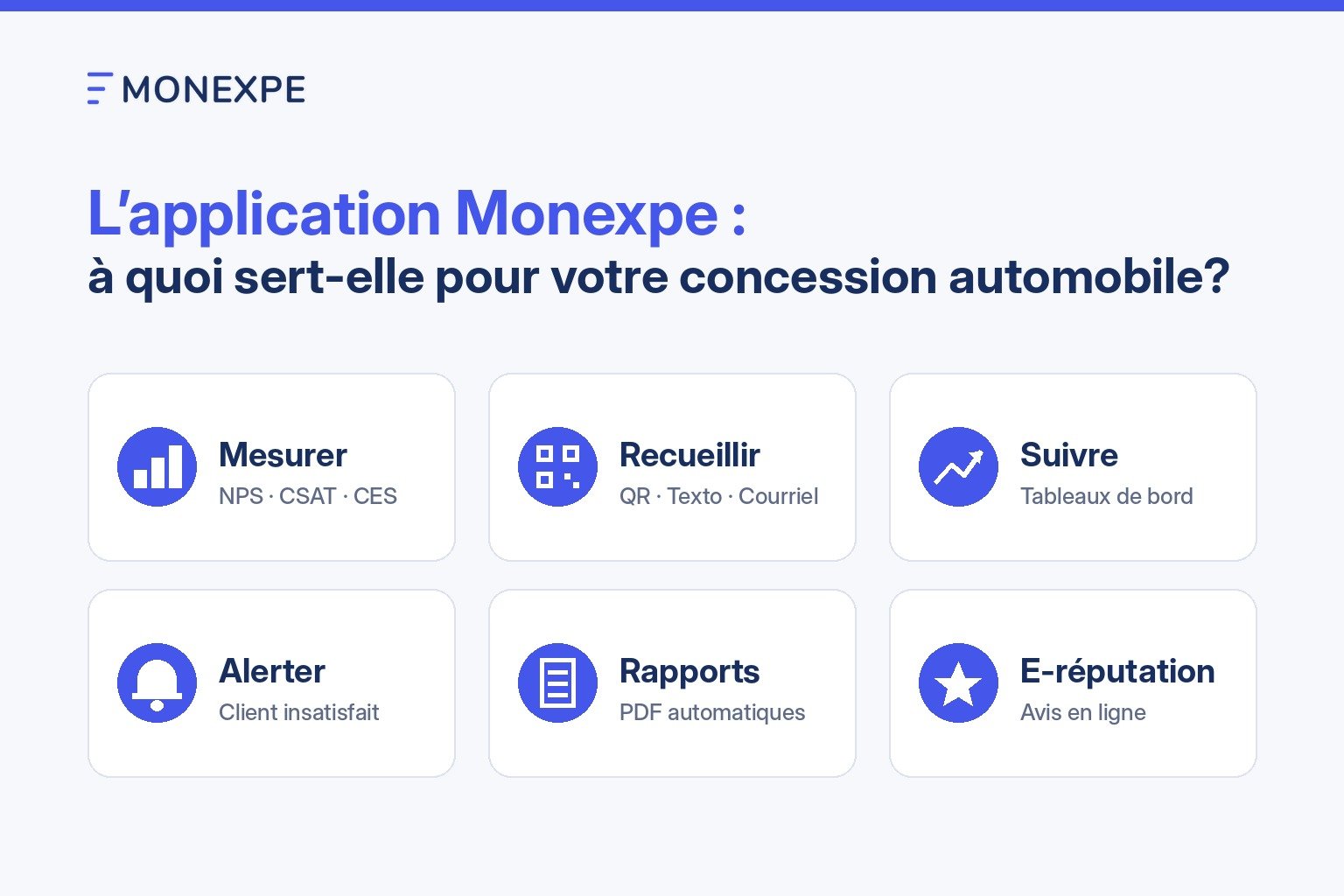
Identifying friction points requires measuring effort and satisfaction at each stage, then tracking the impact of fixes. Monexpe is a customer experience measurement and management platform. It lets you:
- collect comments;
- measure satisfaction with NPS, CSAT, and CES;
- track results over time;
- better manage your online reputation.
For a dealership, this allows you to place a CES after practical steps, identify recurring irritants in comments, and verify month after month whether a fixed friction point truly disappears.
In summary
In the automotive sector, improving customer experience doesn't require transforming everything. It often means finding the few moments when the customer makes an unnecessary effort, starting with those that affect the most customers, and verifying that the fix works. Fix one friction point at a time: the journey becomes simpler, and customers return.
Want to identify the friction points in your customer journey? Discover Monexpe or request a demo.