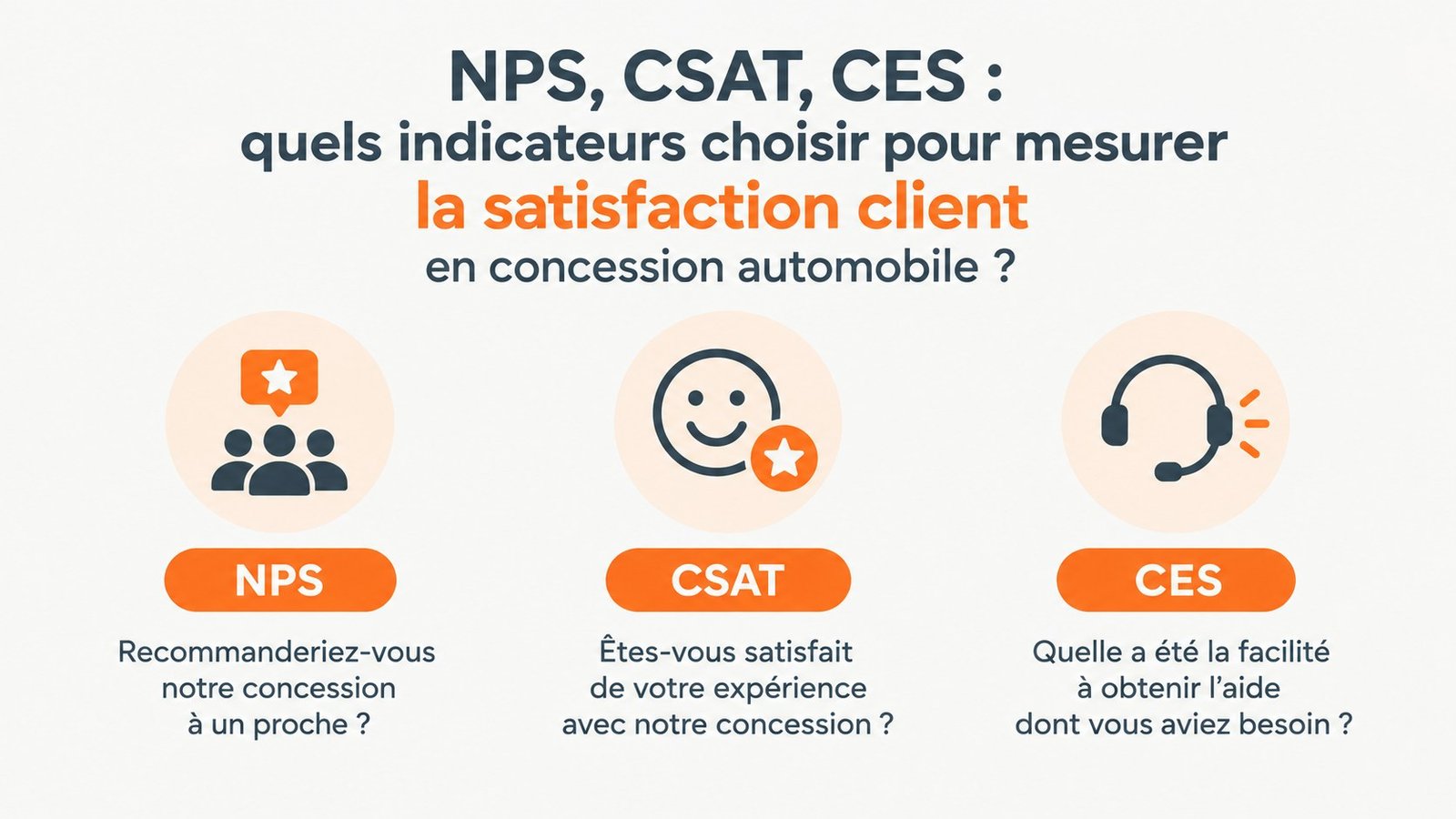
In the automotive sector, there is no single best indicator, but a good indicator for each moment:
- CES measures the effort required by the customer. It is suitable for practical steps, such as appointment booking;
- CSAT measures satisfaction after a specific interaction. It is suitable for a workshop visit or a test drive;
- NPS measures the likelihood that the customer will recommend your dealership. It reflects the overall relationship and is suitable after vehicle delivery or at regular intervals.
Used together and at the right time, these three indicators tell you not only if your customers are satisfied, but also where the problem lies. Here's how each one works and how to combine them in an automotive dealership.
The NPS (Net Promoter Score): measuring recommendation
What it measures
NPS was proposed by Frederick F. Reichheld of Bain & Company in an article in Harvard Business Review published in 2003. It measures the likelihood that a customer will recommend your business to someone close to them. It is a relationship indicator: it reflects the impression left by the entire experience, not just the last visit.
The question and calculation
Typical question: "On a scale of 0 to 10, how likely are you to recommend our dealership to a friend or family member?"
Respondents are classified into three groups:
- Promoters: scores of 9 or 10;
- Passives: scores of 7 or 8;
- Detractors: scores of 0 to 6.
NPS is calculated by subtracting the percentage of detractors from the percentage of promoters. It therefore ranges from −100 to +100.
Example calculation (fictitious figures): out of 100 customers who responded after vehicle delivery, 60 give 9 or 10, 25 give 7 or 8 and 15 give 6 or less. The NPS is 60 − 15 = 45.
Strengths and limitations
Strengths: simple to understand, easy to track over time and useful for identifying detractors to follow up with.
Limitations: it doesn't say what needs to be corrected. Without an open-ended question, an NPS of 45 doesn't tell you whether the problem comes from reception, price or the workshop. It is also poorly suited for evaluating a single interaction, such as a simple phone call.
When to use it at a dealership
- a few days or weeks after delivery of a new or used vehicle;
- at regular intervals, for example once a year, from workshop customers, to track the overall relationship.
CSAT (Customer Satisfaction Score): measuring a specific interaction
What it measures
CSAT measures customer satisfaction with a specific interaction: a workshop visit, a test drive, a delivery, a visit to the parts counter. It is the most direct indicator to evaluate a moment in the customer journey.
The question and calculation
Typical question: "Overall, are you satisfied with your visit to our workshop?", on a scale of 1 (very dissatisfied) to 5 (very satisfied).
The most common method is to calculate the proportion of respondents who give the two highest scores (4 or 5). Other companies use the average score. The important thing is to choose a method and stick with it, so you can compare results from one month to the next.
Example calculation (fictitious figures): out of 200 workshop customers surveyed in one month, 170 answer 4 or 5. The CSAT is 170 ÷ 200 = 85%.
Strengths and limitations
Strengths: precise, easy to link to a moment and a team, useful for tracking the effect of a process change.
Limitations: a customer can be satisfied with a visit without necessarily returning. CSAT measures a moment, not loyalty.
When to use it at a dealership
- within 24 to 48 hours after a workshop visit;
- after a test drive or presentation of an offer;
- after delivery, as a complement to NPS, to evaluate the moment itself.
CES (Customer Effort Score): measuring ease
What it measures
CES measures the effort a customer had to expend to get what they wanted. It is based on an idea presented in 2010 by Matthew Dixon, Karen Freeman and Nicholas Toman in Harvard Business Review: to build loyalty, reducing customer effort matters more than trying to "dazzle" them. In a dealership, it is particularly useful at practical stages, where the irritant is often an overly complicated process.
The question and calculation
Typical question: "The dealership made it easy for me to book an appointment", on an agreement scale of 1 (strongly disagree) to 7 (strongly agree).
CES is often expressed as an average score or as the proportion of customers who give the highest scores. Again, keep the same method over time.
Example calculation (fictitious figures): out of 150 customers surveyed after booking an appointment, 105 answer 6 or 7. The proportion of customers who find the process easy is 105 ÷ 150 = 70%.
Strengths and limitations
Strengths: it directly points to the processes to simplify: phone wait times, overly long forms, customers forced to travel to sign.
Limitations: it is not suitable for assessing the overall relationship or the quality of a repair.
When to use it at a dealership
- after booking a workshop appointment;
- after an information request or online financing request;
- after dropping off or picking up the vehicle.
Which indicator for which moment in the customer journey?
Here is a simple correspondence, to be adapted to your dealership:
- Web request or appointment booking: CES. Key question: "Was it easy?"
- Test drive and showroom visit: CSAT. Key question: "Are you satisfied with this visit?"
- Vehicle delivery: CSAT for the moment itself, then NPS a few weeks later for the relationship.
- Workshop visit: CSAT after each visit, and CES if check-in or pickup is problematic.
- Overall relationship with the workshop: NPS once a year.
Fictitious example, for illustration: a Sherbrooke dealership was using only an annual NPS. Its results were declining without knowing why. They add a CES after appointment booking and a CSAT after each workshop visit. They then discover that visits are rated well, but that appointment booking is considered difficult. The problem does not come from the technicians' work, but from the after-sales service phone line.
Five rules to make your measurements useful
- Always add an open-ended question. The score tells you if there's a problem; the comment tells you which one.
- Send the survey quickly. Within 24 to 48 hours, the memory is still fresh.
- Don't over-solicit. A customer who receives a survey after every call will eventually stop responding. Set a spacing rule.
- Don't skew the responses. Asking for a perfect score skews results and prevents you from understanding your customers.
- Act on the results. Follow up with dissatisfied customers and choose one irritant to fix each month.
Common mistakes
Comparing results calculated differently. A CSAT calculated as a percentage of scores 4 and 5 is not comparable to an average out of 5. Keep the same method, and be wary of comparisons with other companies that don't use the same.
Measuring everything with NPS. Asking for a recommendation after a simple phone call doesn't make much sense and doesn't lead to any decisions.
Only looking at the overall average. Break down results by department (sales, workshop) and by moment in the journey to know where to take action.
How Monexpe can help you
For these three indicators to be useful, they must be collected at the right time, tracked over time and linked to customer comments. Monexpe is a platform for measuring and driving customer experience. It allows you to:
- collect feedback;
- measure satisfaction with NPS, CSAT and CES;
- track results over time;
- better manage your online reputation.
For a dealership, this makes it possible to use each indicator where it is most relevant, from appointment booking to delivery, and to track their evolution in the same place.
In summary
NPS, CSAT and CES are not in competition: they answer three different questions. CES tells you if it's easy, CSAT if the moment went well, and NPS if the relationship is solid. In the automotive sector, dealerships that combine them at the right moments in the customer journey not only know if their customers are satisfied, but also what to correct and where.
Want to measure NPS, CSAT and CES at your dealership? Discover Monexpe or request a demo.