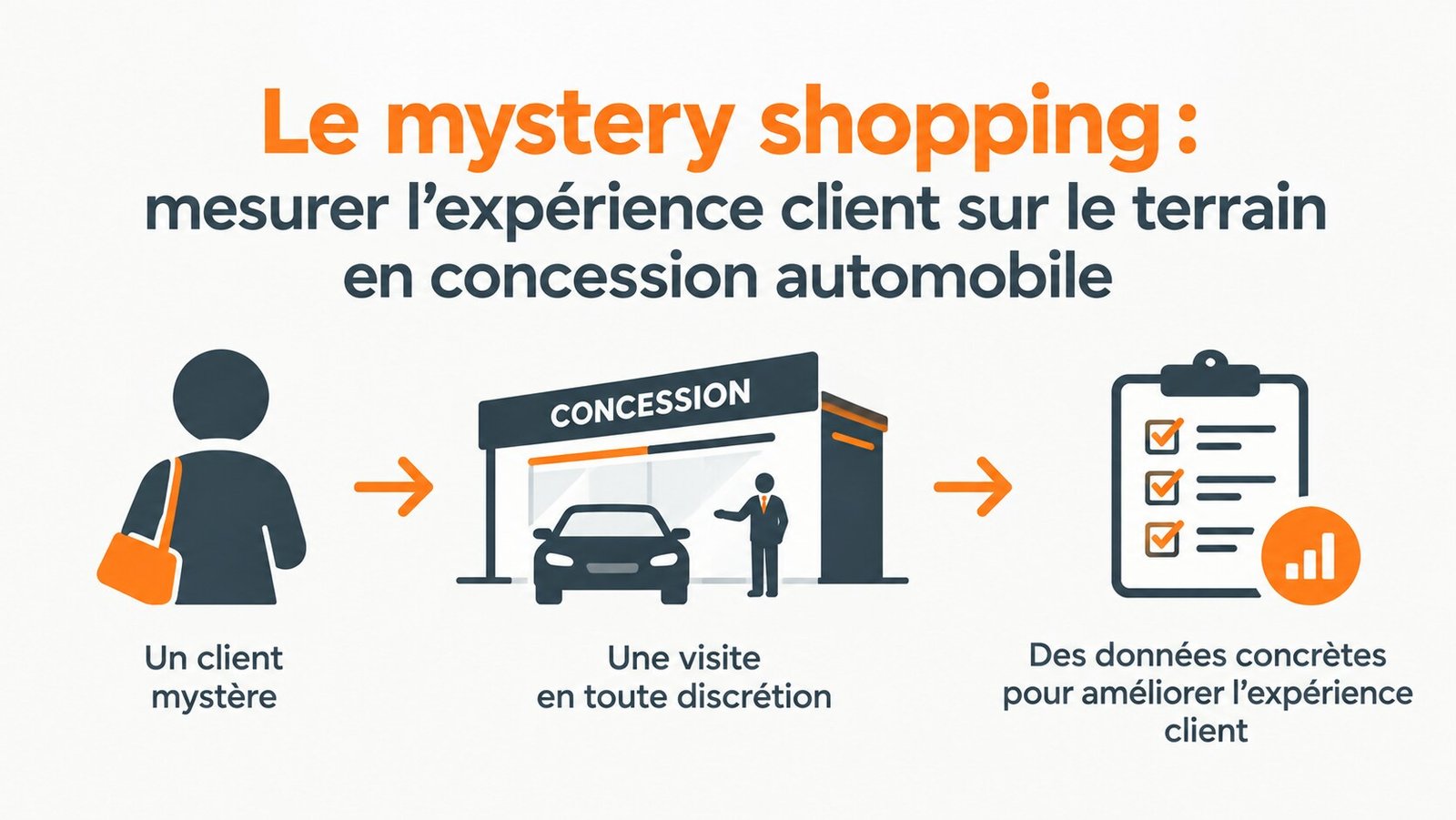
Mystery shopping, or mystery customer, involves having a person pose as an ordinary customer to experience a real interaction, then recording observations using a precise checklist. In the automotive sector, it verifies whether the planned procedures of the dealership are actually being followed: responding to web inquiries, booking workshop appointments, greeting customers on the showroom floor, offering test drives, explaining repairs.
Its value is straightforward: it shows what is really happening, not just what the customer thinks about it. Combined with satisfaction surveys, it reveals both whether the process is being followed and whether that process meets customer expectations. Here's how to use it in your dealership.
What mystery shopping measures, and what it doesn't
A satisfaction survey (NPS, CSAT or CES) measures customer perception: were they satisfied, was the experience easy, would they recommend the dealership? The mystery customer, meanwhile, measures behaviors: did the advisor introduce themselves? Did they offer an appointment? Did the stated price include all fees?
So the two approaches answer different questions.
Mystery shopping
- What it measures: actions and adherence to standards.
- Who responds: a trained evaluator, with a checklist.
- Volume: a few visits or calls per period.
- Strength: precise, factual, covers prospects too.
- Limitation: small sample, simulated situation.
Customer survey
- What it measures: perception and satisfaction.
- Who responds: the actual customer.
- Volume: a large number of responses.
- Strength: representative, reveals what matters to customers.
- Limitation: doesn't always tell you what really happened.
Mystery shopping has another advantage: it allows you to evaluate the experience of prospects—people who haven't yet purchased. A customer survey, meanwhile, never reaches them.
The most useful scenarios in automotive dealerships
Web inquiry to sales
The evaluator sends an inquiry about a specific vehicle in your inventory, from your website or a marketplace. You observe:
- response time;
- whether the response is personal and addresses the question;
- whether an appointment is offered;
- follow-up attempts.
This is the simplest scenario to replicate and repeat. It's also revealing. In the United States, the 2025 Pied Piper study on web inquiry response (Internet Lead Effectiveness) found that 19% of dealerships evaluated did not respond personally to the mystery customer.
Call to the workshop
The evaluator calls to book an appointment for maintenance or report a problem. You observe wait time, phone reception, understanding of the request, offering a specific date and time, and information provided about approximate cost and work duration.
Showroom visit and test drive
The evaluator arrives in person, interested in a model. You observe:
- time before being greeted;
- questions asked to understand their needs;
- vehicle presentation and test drive offer;
- price clarity;
- how the advisor concludes the visit (next steps, contact info, follow-up).
Vehicle drop-off at the workshop
More demanding, this scenario requires an actual vehicle and a real maintenance need. You observe reception greeting, validation of work and pickup time, explanation of any additional work (urgency, cost, authorization), vehicle handover and invoice explanation. This is often the most revealing scenario for after-sales service.
Follow-up after the visit
A few days after a mystery showroom visit, did the dealership call back? Was the message personalized? This scenario easily complements the others and measures a point often overlooked.
Building an evaluation grid that truly works
The quality of a mystery customer program depends mainly on its grid. A good grid is based on observable behaviors, noted as yes or no, rather than impressions.
Avoid: "Was the advisor friendly?" That's subjective, and the answer depends on the evaluator.
Prefer: "Did the advisor introduce themselves by name?", "Did they offer a test drive?", "Did the stated price include all mandatory fees?", "Was a specific pickup time given?"
Pied Piper, the American firm that conducts mystery customer studies in the automotive industry, explains that they built their approach on observation of precise sales behaviors rather than evaluator opinions. This is a good rule to apply, even for an internal program.
Example grid (excerpt) for a workshop call, each criterion noted yes or no:
- The call is answered by a person, with no voicemail system.
- The person answers by stating their name.
- They ask questions to understand the need (mileage, symptoms).
- They offer a specific date and time before the call ends.
- They provide a cost or time estimate, or explain how it will be provided.
- The appointment is confirmed by email or text.
Keep the grid to about ten criteria per scenario, chosen from the actions that matter most to your customers. Comments from your surveys help identify them: if customers often complain about not knowing the cost in advance, this criterion must be in the grid.
Organizing the program: who, how many, how often
Internal evaluators or external agency?
An internal program costs little and works for remote scenarios, like web inquiries or calls. Evaluators can be a management member, a trusted associate, or an employee from another dealership in your group. For in-person visits, a specialized agency provides evaluators unknown to the teams, trained and neutral. Results are then more reliable and easier to gain acceptance for.
How many visits?
A mystery customer represents just one interaction, with one advisor, on one day. A single result doesn't allow you to judge a team. It's better to repeat scenarios regularly, on different days and times (Monday morning at the workshop, Saturday on the showroom floor), and look at trends over several months.
Inform your teams
Tell employees that a mystery customer program exists. Explain what it measures and what the results will be used for, without revealing dates or scenarios. A program presented as an improvement tool is better accepted than one perceived as surveillance. If calls or visits are recorded, have the approach validated by a legal advisor, particularly regarding privacy protection and any collective agreements.
Turning results into progress
Results must lead to concrete actions, not blame. A few principles:
- share results by team or department, rather than targeting one person on a single visit;
- choose two or three criteria each quarter to improve, with training or process changes;
- recognize good results: a well-followed criterion deserves to be highlighted;
- track improvement in targeted criteria during follow-up visits.
Fictional example, for illustration: a Lanaudière dealership conducts six mystery calls to its workshop in one quarter. In four cases, no cost estimate is given or promised. CSAT surveys from the same period contain several comments about "surprise bills." The after-sales service management prepares a short call response guide, with a price range for common maintenance. The next quarter, they track this criterion in mystery calls and monitor the theme in customer comments.
Combining mystery customer and voice of customer
Mystery shopping reaches its full value when combined with both sources. Four situations can occur:
1. Standard met, customers satisfied
The process is working: you must maintain it.
2. Standard not met, customers unsatisfied
The problem is implementation: you must train and equip your teams.
3. Standard met, customers unsatisfied
The standard doesn't meet expectations: you must revise it.
4. Standard not met, customers satisfied
The criterion may matter less than thought, or the sample is too small.
The third situation is the most instructive. It shows that a well-applied process may not be enough, and that the voice of the customer should guide its revision.
Monexpe's role
The mystery customer shows what the dealership is doing; you still need to know what real customers feel. Monexpe is a platform for measuring and managing customer experience. It allows you to:
- collect comments;
- measure satisfaction with NPS, CSAT and CES;
- track results over time;
- better manage your online reputation.
Combined with a mystery customer program, it provides the other half of the picture: your customers' perception of the same moments being evaluated (appointment booking, workshop visit, delivery). You can thus verify that the standards you enforce actually improve their experience.
In summary
In the automotive sector, mystery shopping is a precise tool to verify on the ground whether your standards are being applied: responses to web inquiries, phone reception at the workshop, showroom visit and test drive, vehicle drop-off and follow-up. To be useful, it relies on realistic scenarios, a grid of observable behaviors, repeated visits and a logic of improvement rather than punishment. Combined with your customers' voice, it shows not only what is being done, but also what really matters.
Want to complement your mystery visits with your customers' voice? Discover Monexpe or request a demo.