In the automotive sector, the purchase journey unfolds in six major stages: the trigger and initial research, comparison and shortlisting, contact with the dealership, visit and test drive, trade-in and financing evaluation, then decision and signing. A large part of this journey happens online, often without the dealership knowing, and the customer can drop off at each of these stages.
For an automotive dealership, the challenge is therefore to understand what the customer is looking for at each moment, to provide them with the right information in the right place, and to identify the stage where they abandon. Here's how.
How long does the purchase journey take?
The Vehicle Path to Purchase study was conducted by DIG Insights for AutoTrader in August 2024, with 1,229 Canadians who purchased a vehicle in the previous six months. According to it, buyers of both new and used vehicles typically conclude their purchase in less than three months. During this period, they compare a lot: nearly half of used vehicle buyers also considered a new vehicle.
Concretely, a customer can spend several weeks comparing before writing to you, then expect a response within a few hours. The thinking time belongs to them; the reaction time depends on you.
The six stages, from online search to signing
1. The trigger and initial research
It all starts with a need: an aging vehicle, an expensive repair, a change in family situation, the end of a lease contract. The customer then researches models, prices and reliability, on manufacturer websites, automotive marketplaces and review sites.
The customer's question: « What type of vehicle suits my needs and budget? »
What the dealership can do: at this stage, the customer doesn't know you yet. Useful content (guides, comparisons, answers to frequently asked questions about electric vehicles or financing) and complete vehicle listings make you visible even before comparison.
Useful metric: the number of views of your vehicle listings.
2. Comparison and shortlisting
The customer narrows down their options to a few models and a few dealerships. They compare available inventory, advertised prices and the reputation of each dealership, including reviews of its after-sales service.
In Quebec, price display is regulated. The Office of Consumer Protection (OPC) reminds that the "all-inclusive price" rule prohibits asking for a price higher than the advertised price. Fees that the customer has no choice but to pay, such as administration, preparation or delivery fees, must be included in this price. A clear and complete advertised price is therefore not just a matter of trust: it's also an obligation.
The customer's question: « Which of these dealerships seems most reliable to me? »
What the dealership can do: display all-inclusive prices, keep online inventory up to date and respond to reviews, both positive and negative.
Useful metric: average rating and number of recent reviews, tracked monthly, as well as the dealership's response rate to these reviews.
3. Making contact
This is the first direct exchange: web form, chat, call or text. The customer wants to know if the vehicle is available, confirm its price and organize what comes next. A DIG Insights study for AutoTrader was conducted among Canadian consumers in February 2024. According to it, buyers want to do many steps online: 91% want to be able to research a vehicle online, 86% organize a home test drive, 82% pre-qualify for financing and 82% obtain an evaluation of their trade-in vehicle.
The customer's question: « Do they respond quickly and clearly? »
What causes drop-off: an automated response with no follow-up, a callback the next day, a response that ignores the question asked, an advertised vehicle that is no longer available.
Useful metrics: average first response time (during and outside business hours) and the rate of web inquiries converted to appointments.
4. Visit and test drive
Even if part of the journey happens online, most customers want to see the vehicle and drive it. The customer arrives with a specific idea, and sometimes with information already transmitted online. They expect the advisor to know about it.
The customer's question: « Is this vehicle really right for me, and do I feel welcome here? »
What the dealership can do: prepare the vehicle before the customer arrives, review their file, offer a test drive that matches their actual use (highway, city, country road) and answer technical questions honestly.
Useful metrics: the appointment attendance rate, the share of visits that lead to a test drive and a short CSAT after the visit.
5. Trade-in evaluation, financing and offer
This is often the most tense stage. The customer discovers the value of their trade-in vehicle, financing conditions and the final amount. If they obtained an online estimate, they compare it with the offer received at the dealership.
The customer's question: « Am I paying a fair price, and do I understand what I'm signing? »
What the dealership can do:
- explain how the trade-in value was determined (condition, mileage, market);
- present financing options in a clear manner;
- never leave a gap between the online estimate and the in-person offer without explanation.
The OPC also reminds that no merchant can force a consumer to finance their purchase, nor make the sale conditional on the purchase of additional warranty or a service plan.
Useful metric: the share of presented offers that lead to a sale, and the reasons for refusal noted by advisors.
6. Decision and signing
The customer accepts the offer, signs the documents and plans the vehicle delivery. They expect a clear process, without unnecessary waiting or last-minute surprises.
The customer's question: « Did I make the right choice? »
What the dealership can do: recap in writing what was agreed, prepare documents in advance, confirm the delivery date and process, and introduce at that moment the person who will follow up with the customer later.
Useful metric: an NPS or CSAT sent shortly after signing, broken down by advisor.
Purchase journey summary
1. Trigger and research
Customer's question: What vehicle is right for me?
What the dealership must provide: complete vehicle listings and useful content.
Metric: views of vehicle listings.
2. Comparison and shortlisting
Customer's question: Which dealership is reliable?
What the dealership must provide: a clear all-inclusive price, recent reviews with responses.
Metric: rating and number of reviews; response rate to reviews.
3. Making contact
Customer's question: Do they respond quickly and clearly?
What the dealership must provide: a quick and personalized response.
Metric: first response time; inquiries converted to appointments.
4. Visit and test drive
Customer's question: Is this vehicle right for me?
What the dealership must provide: a ready vehicle, a prepared advisor, a tailored test drive.
Metric: attendance rate; CSAT after the visit.
5. Trade-in, financing and offer
Customer's question: Is this a fair price?
What the dealership must provide: an explained evaluation, clear financing.
Metric: offers converted to sales; reasons for refusal.
6. Decision and signing
Customer's question: Did I make the right choice?
What the dealership must provide: a written recap, a planned delivery.
Metric: NPS or CSAT after signing.
The weak link: transitioning from Web to showroom
The moment when the customer moves from their screen to your showroom is often when the experience breaks down. What they did online is not always communicated to the advisor, and they have to start all over again.
Fictional example, for illustration: a customer completes an online trade-in evaluation request and financing pre-qualification. He shows up the following Saturday. The advisor who greets him doesn't have access to his request, redoes the evaluation and offers him a different amount without explanation. The customer leaves without signing and buys the next day from another dealership, whose offer exactly matched his information.
To avoid this scenario, three reflexes often suffice:
- check, before each appointment, what the customer has already submitted online;
- assign each request to a named advisor who follows the customer until signing;
- ask the customer, in a short survey after his visit, if he had to repeat information. This point measures well with the CES (Customer Effort Score).
Also listen to customers who didn't buy
Customers who buy from you only tell part of the story. Those who visited your dealership then bought elsewhere often reveal the true drop-off points. In the United States, the J.D. Power 2025 study on purchase satisfaction (Sales Satisfaction Index, published in November 2025) specifically measures the satisfaction of these "rejecters". It is based on five factors: the advisor, the price, the facilities, inventory variety and negotiation.
For a dealership, this translates into a simple action: send a few questions to prospects who took a test drive or received an offer without buying, while respecting the consent rules applicable to electronic communications. Even a small number of responses can highlight a recurring irritant, such as a callback delay or lack of price clarity.
And after signing?
The purchase journey ends at signing, but the customer journey continues: vehicle delivery, first service at the workshop, follow-up after the visit and loyalty. The way the purchase went influences what comes next. In Canada, according to the J.D. Power 2026 study on after-sales service for vehicles 4 to 12 years old (CSI-LT, September 2026), 23% of customers who service their vehicle at a dealership say they chose it because of their purchase experience.
How Monexpe can help you track this journey
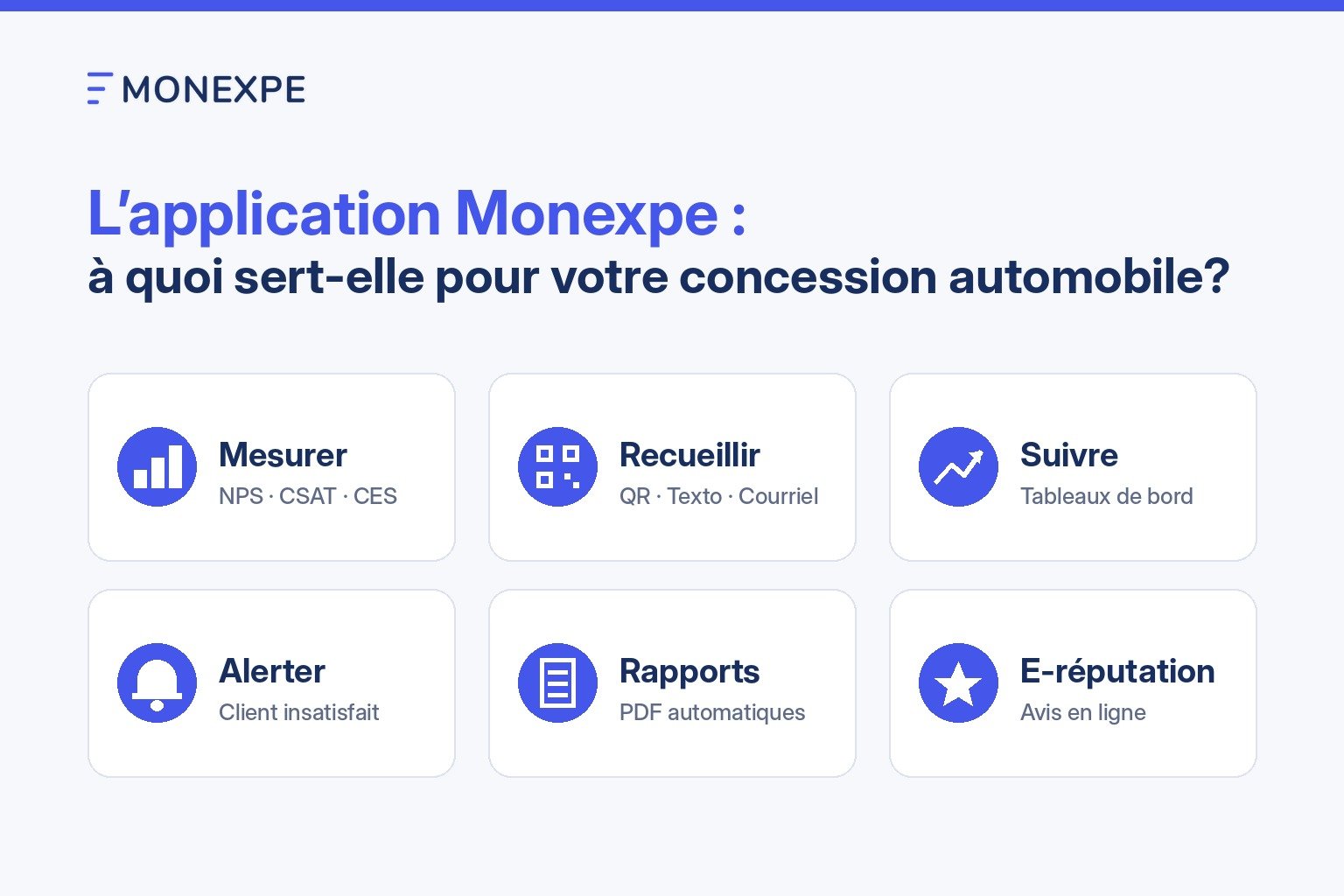
To know at which stage your customers drop off, you need to collect their feedback at key moments and track results over time. Monexpe is a platform for measuring and managing customer experience. It allows you to:
- collect feedback;
- measure satisfaction with NPS, CSAT and CES;
- track results over time;
- better manage your online reputation.
Applied to the purchase journey, it can help you measure the effort felt after a visit, track satisfaction after signing and keep an eye on reviews that influence comparison between dealerships.
In summary
From online search to signing, the customer goes through six stages, and each can bring them closer to or further from your dealership. In the automotive sector, successful dealerships don't just attract inquiries. They know what the customer is looking for at each moment, ensure continuity between Web and showroom, and measure where customers drop off. Start with the most fragile stage at your dealership, often making contact, and track a simple metric for a few months.
Want to know at which stage your customers drop off? Discover Monexpe or request a demo.