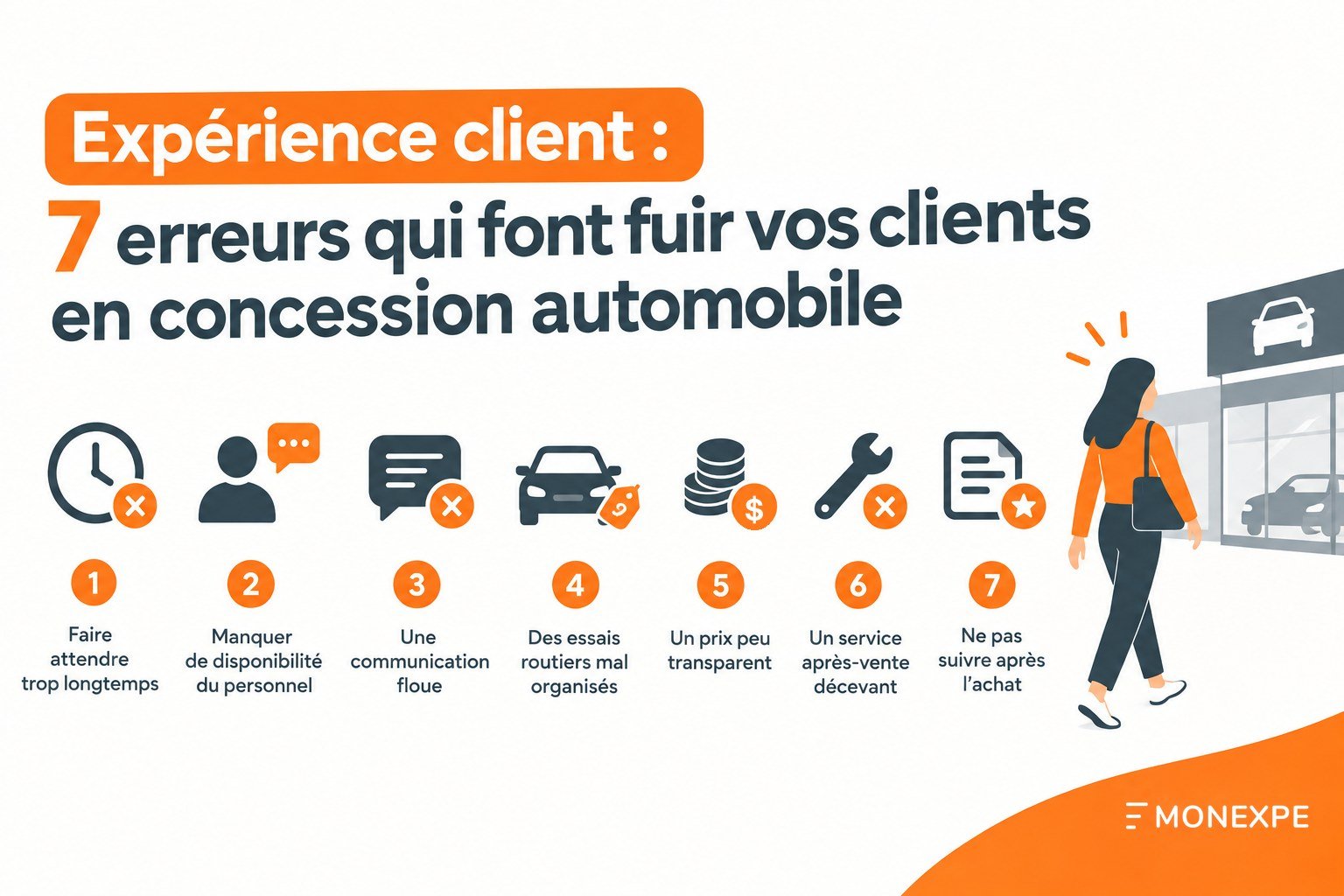
In the automotive sector, a customer rarely leaves a dealership because of a single major problem. They leave after a series of small mistakes: an unanswered call, a higher-than-expected invoice, a wait at the counter, follow-up that never arrives.
The seven most frequent mistakes affect:
- the first contact;
- price transparency;
- timelines;
- workshop explanations;
- vehicle delivery;
- after-sales relationship;
- listening to dissatisfied customers.
The good news is that they can all be corrected with simple actions. Here's how to identify them in your dealership and what to do.
Why these mistakes cost more than before
In Canada, the number of workshop visits is no longer increasing. The J.D. Power 2026 study on after-sales service was published on September 10, 2026 (Customer Service Index – Long-Term, 10,262 vehicle owners aged 4 to 12 years). According to it, the average number of visits remains stable at 1.8 per year at dealerships. Satisfaction is also growing much faster at independent workshops (13 points in one year) than at dealerships (one point). Each lost customer is therefore harder to replace, and competitors are ready to welcome them.
Mistake 1: Leaving requests and calls unanswered
The first contact sets the tone, and yet it often fails. In the United States, the 2025 Pied Piper study on Web request responses (Internet Lead Effectiveness) shows that 19% of evaluated dealerships did not respond personally to the customer. In after-sales service, the irritants noted by Pied Piper during mystery calls are well-known: voicemail, prolonged wait, lost transfer, "call back later". This data is American, but the same situations occur in Quebec.
The sign: customers who write "no one called me back" in their comments or reviews.
The correction: a personal response to each Web request, a person responsible for requests received in the evening and on weekends, and a precise appointment date offered before the end of each workshop call.
Indicators: first response time, call abandonment rate, CES after appointment scheduling.
Mistake 2: Letting the customer discover the real price at checkout
An incomplete posted price or an invoice higher than the estimate gives the customer the impression of being taken advantage of, even when the work was justified. In Quebec, the Office of Consumer Protection reminds us that, according to the all-inclusive price rule, fees that the customer has no choice but to pay must be part of the advertised price.
The sign: comments like "invoice surprise" or counter disputes.
The correction: a written estimate before work, a photo or short video of the part to be replaced, and customer approval before any additional work.
Indicators: average gap between estimate and invoice, share of additional work approved in writing.
Mistake 3: Making the customer wait for vehicle delivery
This is the most marked gap between dealerships and their competitors. In the J.D. Power 2026 study, 52% of dealership customers say they picked up their vehicle quickly, compared to 69% of secondary market workshop customers. Yet, according to the same study, vehicle delivery accounts for 20% of satisfaction with the service.
The sign: a line at the counter at end of day and invoices prepared only upon customer arrival.
The correction: notify the customer by text when their vehicle is ready, prepare the invoice in advance, enable online payment, and reinforce the counter during peak hours.
Indicators: wait time for delivery, share of vehicles ready at promised time.
Mistake 4: Repairing without explaining
A customer who doesn't understand what was done doubts the value of the work. The J.D. Power 2026 study shows that secondary market workshops also outperform dealerships on customer-focused advice (91% versus 89%) and on work done right the first time (94% versus 91%). The gaps are smaller, but they affect trust.
The sign: customers who ask "Why was that necessary?" or who return for the same problem.
The correction: clearly distinguish what is urgent from what can wait, take two minutes at key handover to explain the work, and follow up on repeat visits for the same problem.
Indicators: CSAT on clarity of explanations, repeat visit rate for the same problem.
Mistake 5: Rushing vehicle delivery
Delivery is often treated as a formality, when it leaves a lasting impression on the customer. In the United States, the J.D. Power 2025 study on purchase satisfaction (Sales Satisfaction Index, November 2025) places delivery at the top of factors affecting buyer satisfaction. According to the same study, 22% of buyers would like to receive, after delivery, a follow-up explanation on the functions and controls of their vehicle, but 53% of those buyers never receive it.
The sign: calls with questions in the weeks following delivery, or customers who don't use certain vehicle features.
The correction: a reserved delivery time slot, a checklist adapted to each engine type (electric, hybrid, gasoline), and a follow-up call a few weeks later.
Indicators: NPS after delivery, share of buyers contacted after delivery.
Mistake 6: Forgetting the customer once the sale is complete
A customer treated well during the sale, then treated like a stranger at the workshop, feels the break. Yet it's the workshop that brings them back. According to J.D. Power 2026, 47% of customers who have their vehicle serviced at a dealership say they chose it because of their previous service experience. Only 23% cite their purchase experience.
The sign: few buyers return for their first service.
The correction: introduce the service advisor at delivery, offer the first service appointment before the customer leaves, and make their history visible at the workshop reception.
Indicators: share of buyers who returned for their first service, workshop return rate from one year to the next.
Mistake 7: Not listening, or listening without acting
The last mistake prevents correcting all the others. Some dealerships never ask their customers for feedback. Others ask, but don't call back dissatisfied customers, or mainly seek to get good ratings. Asking the customer for a perfect score boosts the score, but prevents knowing what they really think.
The sign: survey results remain stable while online reviews decline, or customers leave without ever complaining.
The correction: a short survey after each key moment, with an open-ended question, quick follow-up of each dissatisfied customer, and a monthly review of comments to choose one irritant to fix.
Indicators: response time for a dissatisfied customer, number of actions completed from comments.
Fictional example: one visit, multiple mistakes
The following situation is invented to show how these mistakes add up. A customer from Trois-Rivières calls twice before managing to reach the workshop to schedule an appointment. On the day of the visit, he's told his vehicle will be ready "end of day" without a specific time. Additional work is approved over the phone without a clear amount. At 5:30 p.m., he waits at the counter and discovers an invoice higher than expected. No one asks for his feedback afterward.
None of these mistakes is serious on its own. Together, they're enough for him to have his next service done elsewhere, without ever complaining.
Where to start?
No need to fix everything at once. First, identify which mistakes your customers mention most often, in your surveys, online reviews, and remarks heard at the counter. Choose one, fix it, and track the corresponding indicator for a few months, then move to the next.
How Monexpe can help you
To know which of these mistakes affect your dealership, you need to listen to your customers at the right times. Monexpe is a customer experience measurement and management platform. It allows you to:
- collect comments;
- measure satisfaction with NPS, CSAT, and CES;
- track results over time;
- better manage your online reputation.
Concretely, it helps measure effort when scheduling appointments, satisfaction after a workshop visit, and recommendation after delivery. It also helps identify dissatisfied customers and verify that your corrections actually change the experience.
In summary
In the automotive sector, customers don't leave by slamming the door: they leave in silence, after an accumulation of small mistakes. Seven simple habits are often enough to make the difference between a customer who comes back and a lost customer:
- respond to every request;
- announce the real price;
- return vehicles quickly;
- explain the work;
- care for delivery;
- maintain the relationship after the sale;
- listen to customers.
Want to know which of these mistakes affect your dealership? Discover Monexpe or request a demo.