In the automotive sector, online reviews play two roles. For the customer shopping around, they help choose between several dealerships. For the dealership, they are a valuable source of information about what customers actually experience, both in sales and after-sales service.
Managing your online reputation well is therefore not just about getting a good rating. It's about reading reviews as a diagnosis, responding to them carefully, obtaining more reviews while respecting the rules, and correcting what they reveal. Here is a practical method, adapted to automotive dealerships in Quebec, and the rules you need to know to avoid unpleasant surprises.
What reviews really say about your dealership
An online review is rarely written by chance. It usually follows a significant moment: a successful delivery, a salesperson who took time to explain things, or conversely a delay at the service department, an unexpectedly high bill, a call never returned. Read one by one, reviews can seem anecdotal. Read together, they paint a fairly accurate picture of your strengths and pain points.
Reviews do have their limitations, however. Very satisfied or very dissatisfied customers are more willing to write than others, and a single review doesn't describe an entire team. The customer voice is better understood by combining two sources:
- public reviews, spontaneous and visible to all;
- internal surveys (NPS, CSAT, CES), sent to all customers and more representative.
A five-step method to manage your online reputation
1. Inventory your platforms
Identify all the places where your customers talk about you: Google Business Profile, automotive-specific sites, social media, marketplaces. Verify that basic information is accurate (service department hours, after-sales service number, address). An error here creates a pain point before the first visit even happens.
If your services have different hours, make sure customers can easily find the correct contact information for the service department, sales, and parts.
2. Read and classify reviews each week
Designate one person responsible for reading reviews, with a set time each week. Classify each review according to two criteria:
- the service involved: sales, financing, delivery, service, parts;
- the theme: turnaround times, pricing and cost transparency, communication, customer service, repair quality, cleanliness.
After a few months, this classification reveals trends that no single review shows on its own. A dealership might discover, for example, that its positive reviews mainly concern sales advisors, while most negative reviews concern service department delays.
3. Respond to all reviews, positive and negative
A response addresses two readers: the customer who wrote it, and all future customers who will read it. It shows how your dealership reacts when something goes wrong.
For a positive review: thank the customer in a personalized way, referencing a specific element of their comment, without using a copy-paste formula.
For a negative review:
- respond quickly;
- acknowledge the experience without lengthy justification;
- offer to continue the conversation offline with a named person;
- do not disclose any personal information about the customer (file number, billing details, maintenance history). In Quebec, Law 25 governs the protection of personal information: when in doubt, keep things general.
What to avoid: publicly contradicting the customer point by point, blaming an employee, promising a gesture or compensation in exchange for removing the review.
4. Request reviews while following the rules
Asking your customers for reviews is permitted and useful, provided you do it correctly. Google Maps' rules on prohibited content specify that a business must not:
- offer compensation (payment, discount, free product or service) in exchange for a review, or in exchange for modifying or removing a negative review;
- discourage negative reviews, or solicit only customers likely to leave a positive review;
- require or pressure a customer to write a review on site, or ask them to include specific content;
- ask employees to obtain a certain number of reviews, or reviews that mention a staff member.
The last two points target common dealership practices: the salesperson handing the customer a tablet at vehicle delivery, or a monthly review target per employee with their name mentioned. These practices need to be reviewed.
The best practice is simple: invite all customers, without filtering based on their satisfaction, to honestly share their experience, for example in a follow-up message after their visit.
5. Transform reviews into action
Once a month, present to management and department heads the three most frequent themes in negative reviews and the three most cited in positive reviews. For each recurring pain point, assign a responsible person and an action. When the problem is fixed, mention it in your responses to related reviews.
Fictional example, for illustration purposes: a dealership in the Montérégie notices that several negative reviews mention unreturned calls to the service department. Upon checking, it discovers that the after-sales service line goes to voicemail that is checked only once a day. It assigns a team member to retrieve messages every hour and adds online appointment booking. In the following months, it verifies whether this theme declines in new reviews.
Employees and reviews: a matter of transparency
It can be tempting to ask employees or their family members to publish reviews to boost your rating. The Competition Bureau of Canada reminded us in January 2024 that employees who publish reviews about their employer or its competitors must disclose their connection to the business, even if they give an honest opinion. The business can also be held responsible for reviews that mislead consumers.
For a dealership, the rule to remember is clear: no reviews from employees or close relations presented as customer reviews. The best approach is to train teams on this point and include it in an internal policy.
Key metrics to track
1. Average rating and number of recent reviews
What it measures: current perception, not just history.
Frequency: monthly.
2. Review response rate
What it measures: the dealership's presence in the conversation.
Frequency: monthly.
3. Average response time to negative reviews
What it measures: responsiveness to a dissatisfied customer.
Frequency: monthly.
4. Distribution of reviews by service and theme
What it measures: the origin of pain points and strengths.
Frequency: monthly or quarterly.
5. Gap between public reviews and internal surveys
What it measures: whether reviews accurately reflect your entire customer base.
Frequency: quarterly.
This last metric is often overlooked. If your internal surveys show high satisfaction at the service department while public reviews of this service are mostly negative, you need to understand why. The survey may be poorly targeted, a very dissatisfied minority may be more vocal, or a real problem may be escaping the survey.
How Monexpe can help you
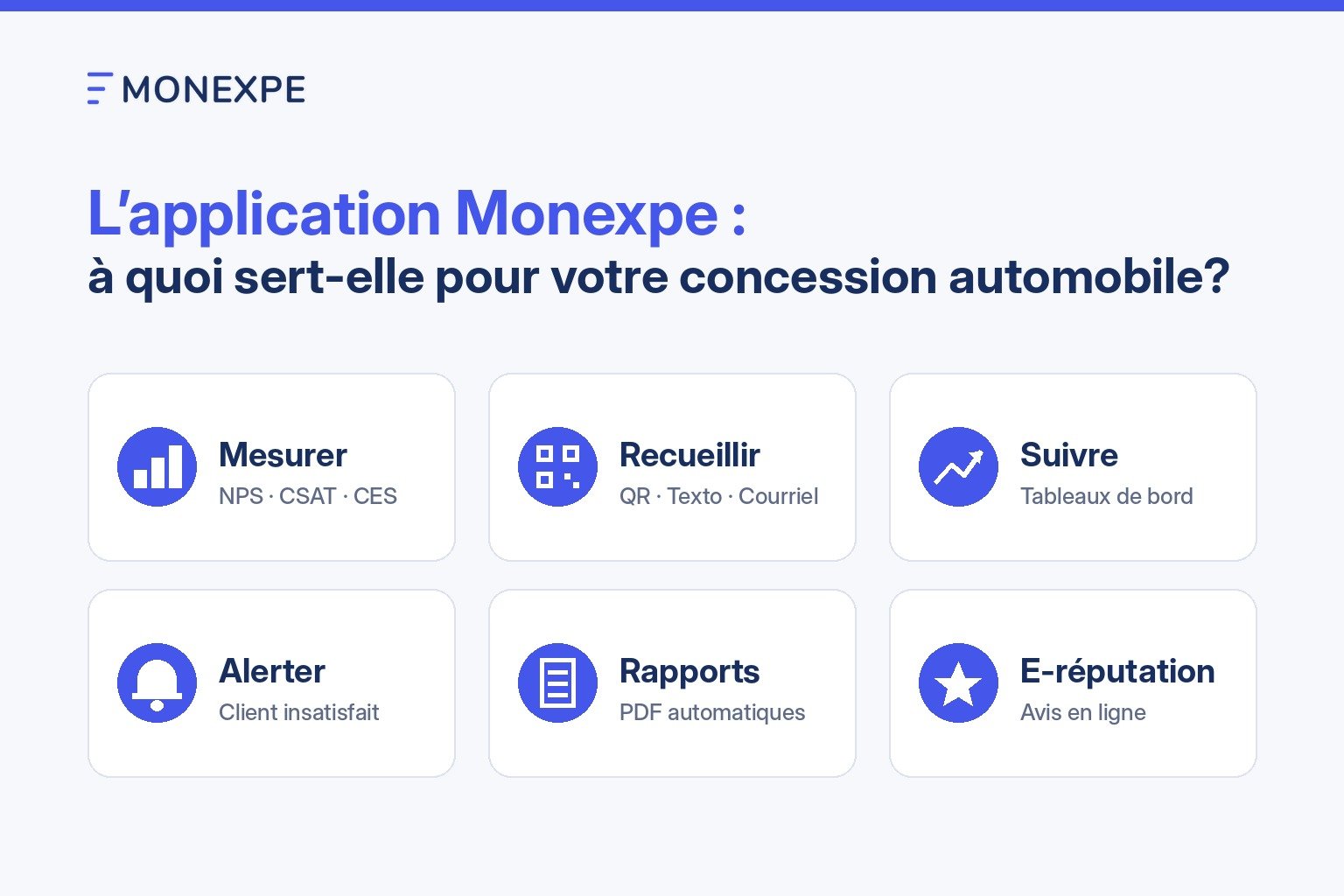
Understanding the customer voice requires bringing together what is said publicly and what your customers tell you directly. Monexpe is a platform for measuring and managing customer experience. It allows you to:
- collect feedback;
- measure satisfaction with NPS, CSAT and CES;
- track results over time;
- better manage your online reputation.
For a dealership, this helps track online reviews and surveys in one place, identify recurring themes, and verify, month after month, whether the actions taken are changing customer perception.
In summary
In the automotive sector, customer reviews are both a showcase and a diagnostic tool. Dealerships that get the best from them read them regularly, respond to them carefully, and solicit them from all customers, without incentives or pressure. They then use them to correct pain points, at the service department and in sales. A good online reputation is built first on real experience.
Want to better understand your customers' voice? Discover Monexpe or request a demonstration.