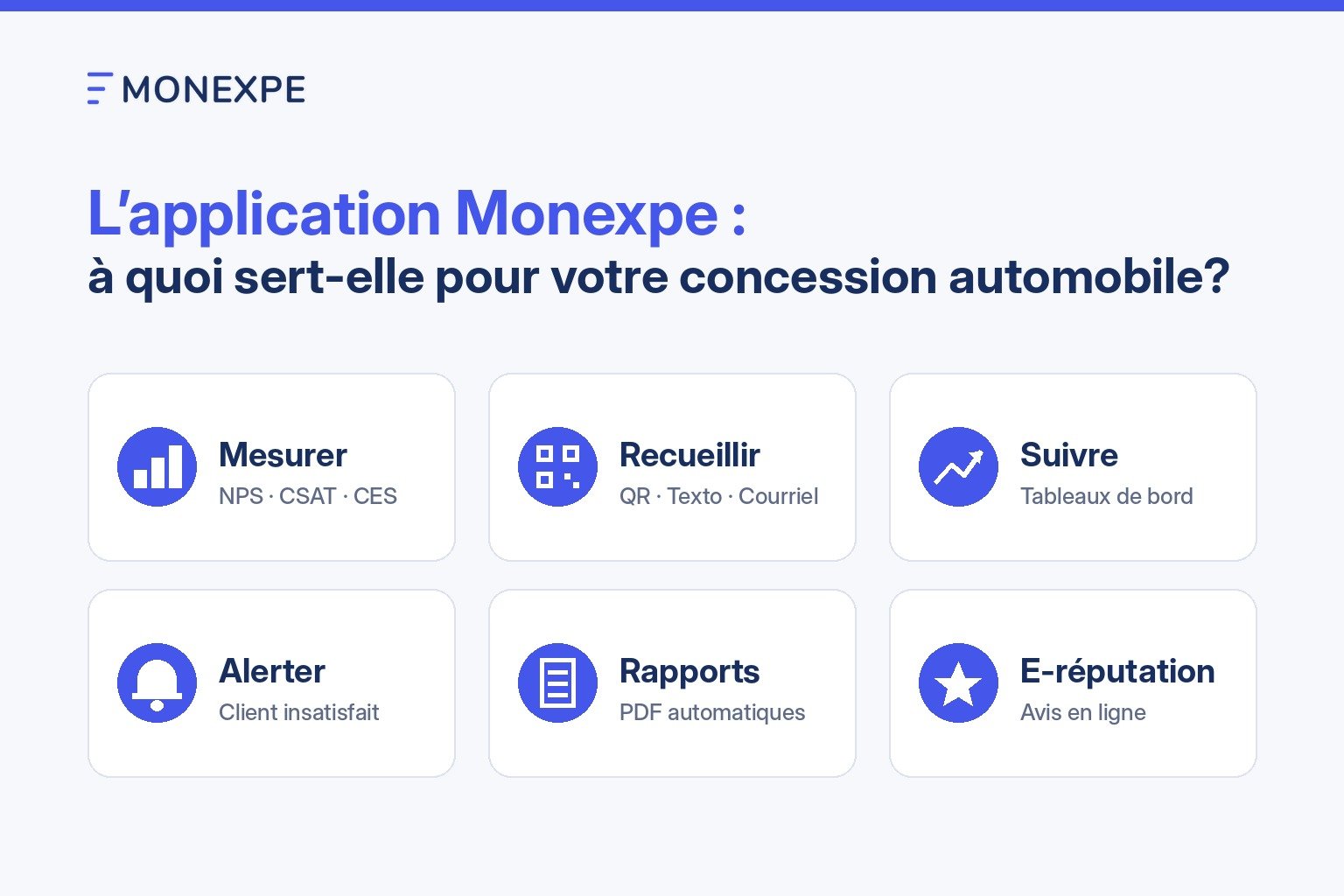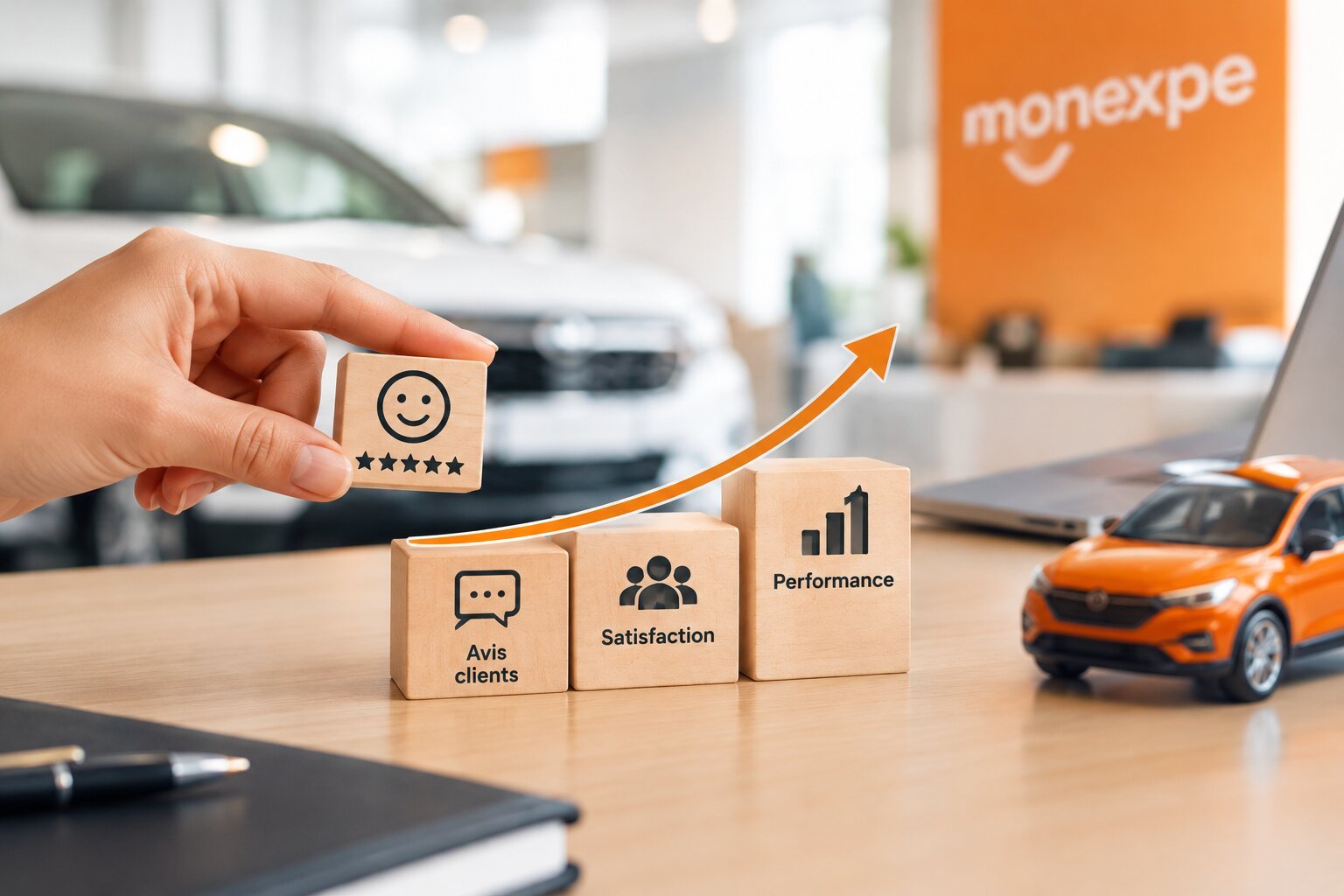
In the automotive sector, customer experience transforms into performance when you connect what customers experience to what they do next: return to the service department for maintenance, buy their next vehicle from the dealership, recommend it, or leave a review. Monexpe helps make this connection: the platform allows you to collect customer feedback, measure satisfaction with NPS, CSAT, and CES, track results over time, and better manage your online reputation.
For an automotive dealership, its benefits come down to five points:
- see where the experience is degrading;
- recover dissatisfied customers;
- choose the right initiatives;
- strengthen online reputation on real foundations;
- give teams common benchmarks.
This article presents them one by one, with the performance indicators to track, then proposes a method to build your own profitability analysis.
Why customer experience is a performance issue at the dealership
A large portion of a customer's value is generated after the sale, at the service department. The J.D. Power 2026 study on after-sales service in Canada was published on September 10, 2026 (Customer Service Index – Long-Term, 10,262 owners of vehicles 4 to 12 years old). According to it, dealerships perform 49% of maintenance and repair visits, but capture 63% of service revenue. The average spending per visit at a dealership reaches $566, up 5% year-over-year.
In other words, each customer who continues to have their vehicle serviced at the dealership represents recurring revenue, and each customer who leaves for an independent shop takes that revenue with them. Yet this choice largely depends on the experience they had. According to the same study, 47% of customers who have their vehicle serviced at a dealership say they chose it based on their previous service experience.
From satisfaction to performance: the chain to track
To transform customer experience into performance, you must track a chain of four links.
1. The experience: what the customer goes through
At the dealership: appointment booking, reception at the service department, explanation of repairs, vehicle delivery.
2. The perception: what they think about it (NPS, CSAT, CES, comments)
At the dealership: CSAT after the service visit, CES after booking the appointment.
3. The behavior: what they do next
At the dealership: return for the next maintenance, vehicle purchase, online review, recommendation.
4. The result: the impact on the dealership
At the dealership: service department revenue, sales to existing customers, online reputation.
Most dealerships measure link 4 (financial results) and sometimes link 2 (a satisfaction score), without connecting the two. Yet it's this connection that lets you know which improvements are worth the effort.
One caution is necessary: an observed link between satisfaction and revenue doesn't by itself prove that one causes the other. The most reliable way to verify it is to track your own data over time, before and after a process change.
The concrete benefits of Monexpe for a dealership
1. See where the experience is degrading
The problem: management often learns that a service is struggling through a complaint, a negative review, or a revenue decline—in other words, too late.
What Monexpe enables: collect customer feedback after specific moments (service visit, delivery, appointment booking) and track results over time. A drop in service department CSAT or an increase in perceived effort at appointment booking becomes visible before it translates into customer departures.
Associated performance indicator: rate of return to the service department for the next maintenance.
2. Recover dissatisfied customers before they leave
The problem: many unhappy customers don't complain; they simply go elsewhere next time.
What Monexpe enables: by systematically collecting customer feedback, the dealership identifies those who had a bad experience. It can call them back quickly, while there's still time to fix the situation.
Associated performance indicators: share of dissatisfied customers contacted, then share of those customers who return to the dealership.
3. Choose the right initiatives
The problem: resources are limited. Should you train service advisors, reorganize appointment booking, review vehicle delivery? Without data, the decision relies on intuition.
What Monexpe enables: tracking results and comments at each step of the customer journey helps identify the most frequent and most damaging pain points. You invest first where the gap is largest.
Associated performance indicator: change in the targeted indicator and the behavior linked to it, before and after the improvement.
4. Strengthen online reputation on real foundations
The problem: the online rating influences the choices of future customers, but it only improves sustainably if the experience improves.
What Monexpe enables: track reviews in parallel with surveys, to correct the causes of negative reviews rather than mask their effects.
Associated performance indicators: change in average rating and volume of recent reviews, and share of negative reviews focusing on a pain point already fixed.
5. Give teams common benchmarks
The problem: sales, financing, and the service department each have their own objectives. Customer experience becomes "everyone's responsibility," which means no one's.
What Monexpe enables: shared indicators (NPS, CSAT, CES) and customer comments that each manager can access. Discussions focus on facts rather than impressions.
Associated performance indicator: number of improvement initiatives launched and completed each quarter.
Building your own profitability analysis
Rather than relying on general figures, use your own data. Here's a simple method, focused on the service department, to apply with your controller or service manager.
Step 1: estimate the value of a customer at the service department
Multiply three pieces of data from your management system:
- the average revenue per visit paid by the customer;
- the average number of visits per year;
- the average number of years a customer stays loyal to your service department.
The result gives you an order of magnitude for the value of a loyal customer.
Step 2: measure what you're losing today
Count the number of customers who didn't return for their next maintenance over the past year, then multiply by the value calculated in Step 1. You get an estimate of the revenue leaving the dealership.
Step 3: link departures to experience
After a few months of measurement, compare the return rate of satisfied customers to that of dissatisfied customers. If the gap is significant, improving the experience has a direct effect on your service department revenue. If it's small, other factors (price, location) weigh more heavily, and that's also useful information.
Step 4: set a realistic goal and track it
Estimate what the return of a small additional share of customers would generate, then compare that amount to the cost of the initiative (tool, team time). Then track the actual result, quarter after quarter.
This method has nothing spectacular about it, but it has one decisive advantage: it's based on your own figures, which your management and partners know and recognize.
Pitfalls to avoid
Chasing the score rather than the experience. If teams are judged only on a rating, the temptation to "coach" customers to respond well becomes strong. The score goes up, but knowledge of the customer goes down.
Tying compensation too quickly to individual ratings. First use the results to learn and improve processes, and reserve goals for collective indicators.
Measuring without acting. An initiative that produces reports without decisions ends up wearing out surveyed customers and teams alike. Each monthly review should end with at least one concrete action.
In summary
In the automotive sector, customer experience transforms into performance when you connect it to customer behavior and dealership results. This is especially true at the service department, which generates a large share of recurring revenue. Monexpe supports this approach by allowing you to collect feedback, measure satisfaction with NPS, CSAT, and CES, track results, and better manage online reputation. The return, meanwhile, is demonstrated with your own data, quarter after quarter.
Want to evaluate what customer experience represents for your dealership? Discover Monexpe or request a demo.