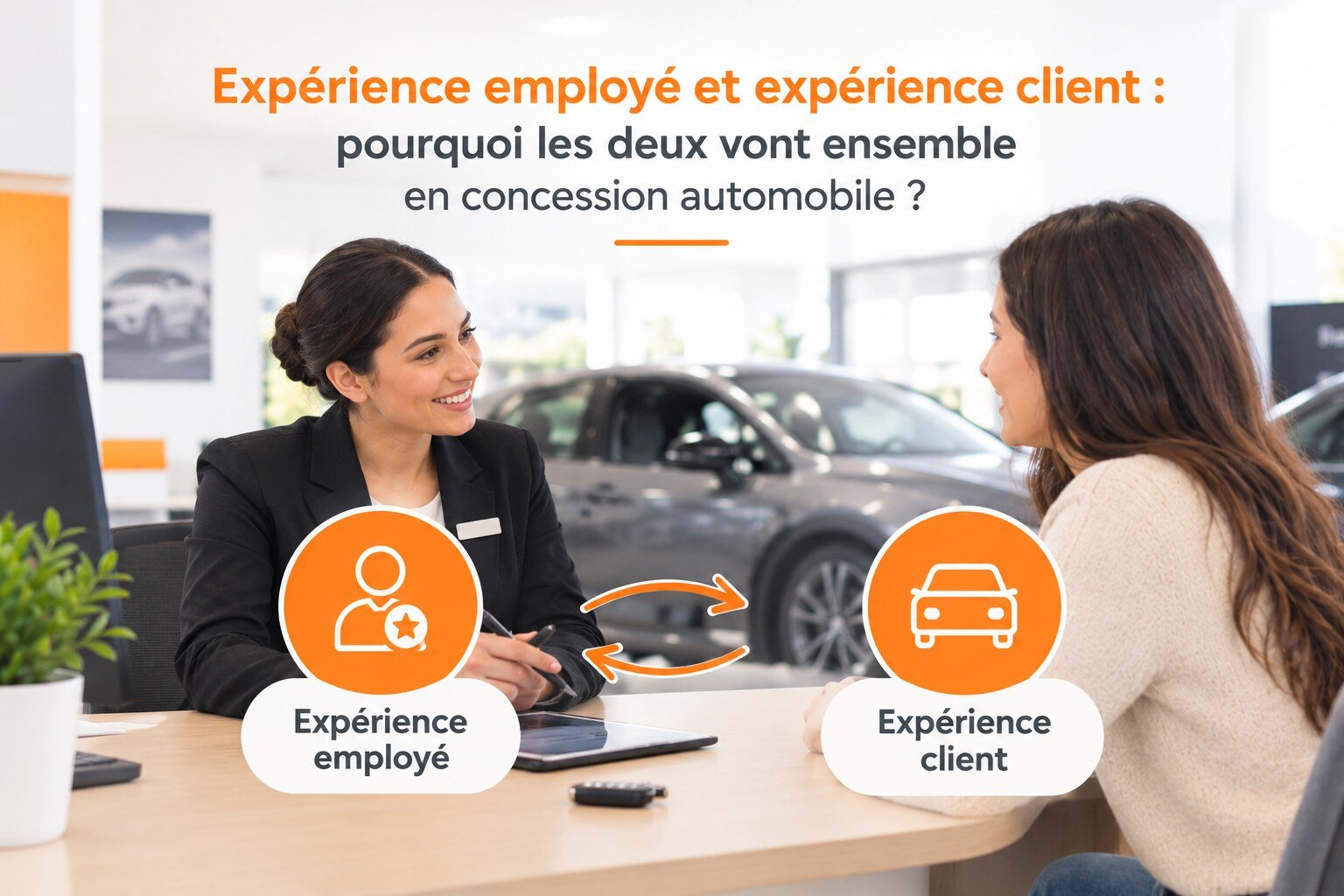
In the automotive sector, customer experience almost always goes through an employee: the person who answers the phone, the sales advisor, the technical advisor, the technician, the cashier at the counter. An overwhelmed employee, poorly equipped or never informed of what customers think can hardly provide a good experience, even with the best intentions.
Employee experience and customer experience therefore go hand in hand. Improving one without taking care of the other rarely produces lasting results. Here's why, and how to act on both at the same time in a car dealership.
A link known for a long time
The idea is not new. In 1994, Harvard researchers described in the Harvard Business Review what they called the "service-profit chain". According to this model, satisfied and well-supported employees provide better service. This service creates satisfied and loyal customers, and these loyal customers support the growth and profitability of the company.
This model does not guarantee a specific result. It simply reminds us that the quality of service depends on the conditions under which teams work.
In a dealership, this link is visible every day. According to the J.D. Power 2026 study on after-sales service in Canada, published on September 10, 2026, the technical advisor alone accounts for 15% of satisfaction with the service. The quality of service, which depends largely on technicians, represents 32%. Behind these figures are people.
Where employee experience directly touches the customer
On the phone and at reception
A receptionist managing three lines and a queue at the counter alone cannot provide the same welcome as a colleague supported during peak hours. Lost calls and long waits often come from a lack of resources, not a lack of good intentions.
With the technical advisor
The technical advisor is at the center of the workshop experience. He welcomes the customer, explains the work, announces overruns and returns the vehicle. If he doesn't have access to the customer's history, if he learns of a delay at the last moment or if he has to defend an invoice he doesn't understand himself, the customer feels it immediately.
With the technician
A technician under pressure, with inadequate tools or incomplete information on the work order, is more likely to have to redo work. For the customer, a vehicle that comes back for the same problem is one of the worst possible experiences.
In sales
A sales advisor judged solely on volume will be tempted to rush the customer, oversell or neglect vehicle delivery. The objectives set by management directly influence the experience of the buyer.
Five actions to improve both at the same time
1. Share the voice of the customer with the teams
Employees more willingly improve what they see. A short monthly review, with a few customer comments read aloud (positive and negative), makes customer experience concrete. Positive comments that mention an employee are also an excellent source of recognition.
Indicator: number of customer comments shared with teams each month.
2. Listen to employees too
Front-line employees often know the irritants before they appear in surveys. A simple question at the weekly meeting is enough: "What prevented you from serving a customer well this week?" The answers often point to a process to correct: slow software, missing parts, information that doesn't circulate.
Indicator: number of irritants reported by teams, then corrected.
3. Give the right tools and the right information
A customer file visible to all, a complete work order, a simple way to inform the customer of a delay: these tools make the teams' work easier and at the same time improve the customer's experience.
Indicator: CES (customer effort) at stages where a new tool has been implemented.
4. Avoid objectives that encourage bad behavior
Linking compensation to individual survey scores encourages "preparing" customers to respond well, rather than serving them better. Favor collective objectives, by department, and use results first to learn.
Indicator: evolution of results by department, not by individual.
5. Recognize what works well
A customer who writes "my advisor took the time to explain everything to me" gives the dealership a concrete example to recognize and reproduce. Point out these moments to the team: it's simple, free and motivating.
Indicator: number of positive mentions of employees in comments and reviews.
Fictional example, for illustration purposes: in a dealership in the Quebec region, customer comments at the workshop often talk about delays announced too late. By listening to the technical advisors, management discovers they have no simple way to know where each vehicle is at. It sets up a quick check-in with technicians at 2 p.m. and a text message template to notify customers. The advisors say they are less stressed at the end of the day, and the theme of unannounced delays recedes in comments in the following months.
What to avoid
- Using the voice of the customer to punish. An employee who fears surveys will end up fearing them more than using them.
- Always asking for more without removing irritants. Adding service steps without addressing underlying problems exhausts teams.
- Forgetting back-office teams. Technicians, preparators and parts clerks don't always see the customer, but their work shows up in his experience.
How Monexpe can help you
Sharing the voice of the customer with teams requires collecting it regularly and making it clear. Monexpe is a customer experience measurement and management platform. It allows you to:
- collect comments;
- measure satisfaction with NPS, CSAT and CES;
- track results over time;
- better manage your online reputation.
For a dealership, this helps present results by department to teams, identify positive comments to highlight and verify that changes made actually improve what customers experience.
In summary
In the automotive sector, every moment of customer experience goes through an employee. Informed, well-equipped, listened to and recognized teams serve customers better. Share the voice of the customer with your teams, listen to what they tell you about irritants, correct the processes that prevent them from serving well and recognize what works. You will improve both your employees' experience and your customers' experience.
Do you want to share the voice of your customers with your teams? Discover Monexpe or request a demonstration.